
Safety · Radiation physics2 min read5-question check
X-ray Production and Target Interactions
Electrons hit the tungsten target: about 99% of their energy becomes heat, under 1% becomes x-rays.
How it works
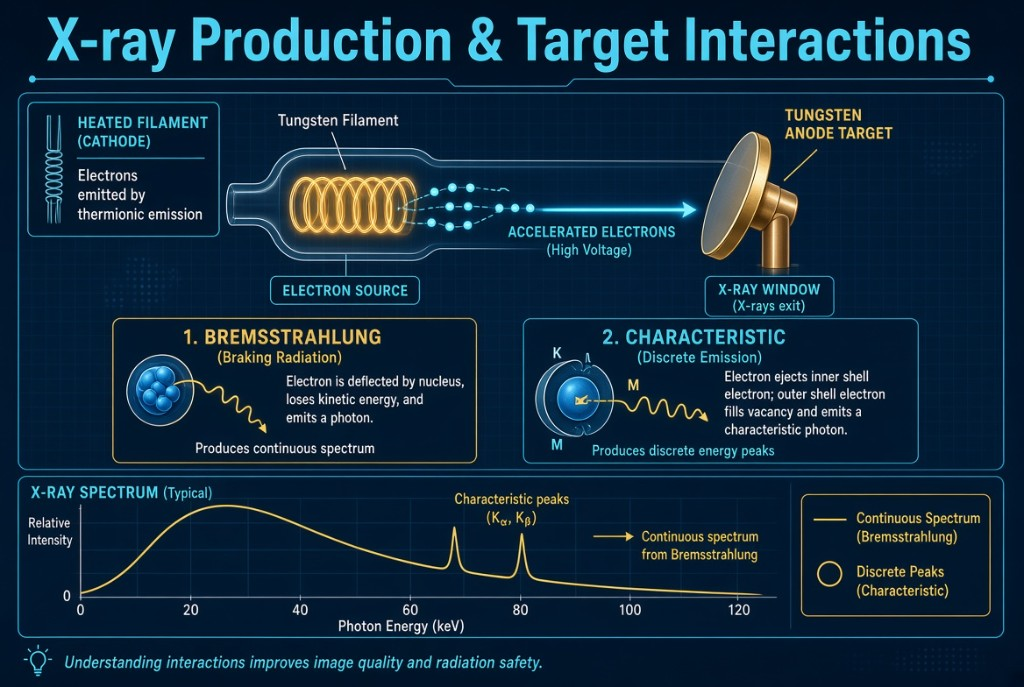
Heating the filament boils off electrons by thermionic emission. The kVp accelerates these projectile electrons from cathode to anode, where they strike the tungsten target. Most of the time a projectile electron only excites outer-shell electrons of target atoms, which produces heat. About 99 percent of the electrons' energy becomes heat and less than 1 percent becomes x-rays. That is why tube heat limits matter.
X-ray production and target interactions
Two kinds
Bremsstrahlung, German for braking radiation, happens when a projectile electron passes close to a nucleus, is slowed and bent, and gives up energy as an x-ray photon. It can lose any amount, from a little to all of its energy, so bremsstrahlung forms a continuous spectrum, and it makes up most of the diagnostic beam. Characteristic radiation happens when a projectile electron knocks out an inner-shell electron. An outer-shell electron drops in to fill the hole and releases a photon equal to the difference in the two shells' binding energies. Those energies are fixed by the target element, so characteristic photons appear as sharp spikes on the spectrum.
The numbers
Tungsten's K-shell binding energy is about 69.5 keV, so useful K characteristic x-rays, roughly 57 to 69 keV, are made only when kVp is about 70 or higher. The maximum photon energy in keV equals the kVp. Worked example: at 90 kVp, no photon can exceed 90 keV, and the average energy is roughly one-third to one-half of that. Raising kVp increases both the quantity and the energy of the beam and shifts the curve to the right, but the characteristic spikes stay at the same energies. Raising mAs increases quantity only. Added filtration removes low-energy photons, so average energy rises while quantity falls.
Clinical Example
A technologist raises a knee technique from 70 to 80 kVp. The bremsstrahlung curve grows and now extends to 80 keV, but tungsten's characteristic spikes stay where they were. Because the beam is more penetrating, the mAs can be cut roughly in half by the 15 percent rule.
Common Mistakes
- Thinking most electron energy becomes x-rays, when about 99 percent becomes heat.
- Mixing up the two: bremsstrahlung is the continuous spectrum, characteristic radiation gives the discrete spikes.
- Believing kVp moves the characteristic spikes, when only the target element sets their energies.
- Forgetting that the highest photon energy in keV equals the kVp.
Why It Matters
These interactions explain why tubes overheat, why kVp controls penetration, and why filtration lowers skin dose. The registry asks you to identify each interaction and predict how kVp, mAs, and filtration change the spectrum.
Key Relationships
- About 99% heat, less than 1% x-rays
- Maximum photon energy (keV) = kVp
- kVp ↑ → quantity and energy ↑, spectrum shifts right
- mAs ↑ → quantity ↑, energy unchanged
- Characteristic energies are set by the target; tungsten K-shell ≈ 69.5 keV