
Patient Care · Assistance, monitoring and emergencies2 min read5-question check
Vital Signs and Monitoring
Know adult normal ranges, take your own baseline, and report any significant change right away.
The rule
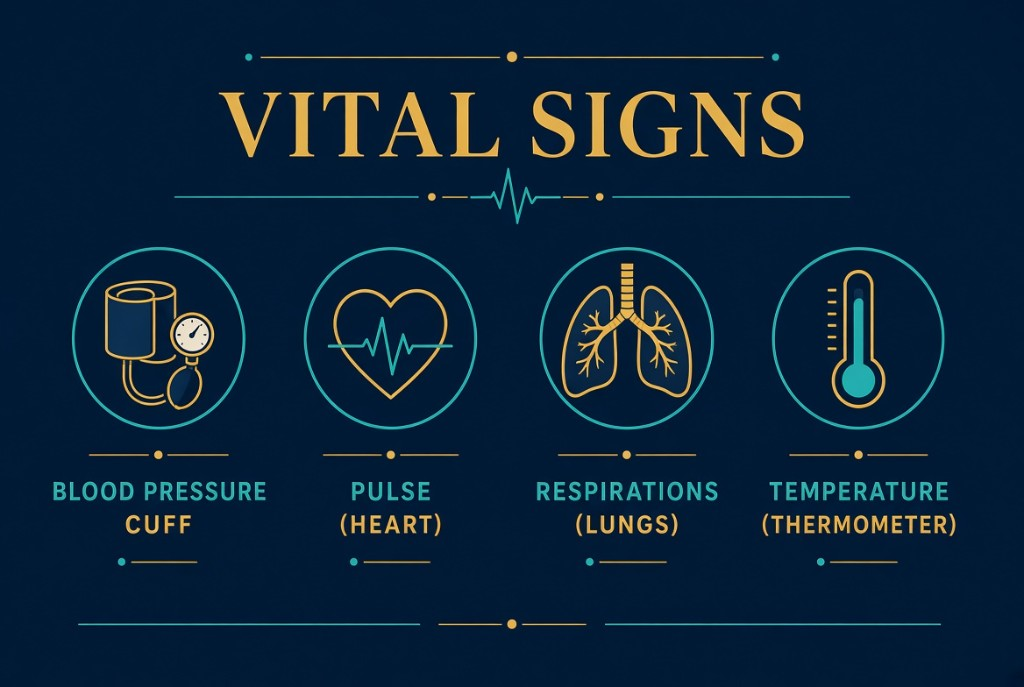
Vital signs are the four core measurements of how the body is working: temperature, pulse, respirations, and blood pressure. Many departments also record oxygen saturation by pulse oximetry. Take a baseline before contrast injections, with sedated or unstable patients, and whenever someone looks unwell. The baseline matters because a change from the patient's own normal tells you more than any single number.
Vital signs
The numbers
For a resting adult, normal pulse is 60 to 100 beats per minute. Above 100 is tachycardia and below 60 is bradycardia. Normal respirations are 12 to 20 breaths per minute. Average oral temperature is about 98.6 °F, or 37 °C. Normal blood pressure is below 120 systolic and below 80 diastolic, and a reading below about 90 over 60 is hypotension. Oxygen saturation is normally 95 to 100 percent. Infants and children have faster pulse and breathing rates, so judge them against age-based norms. Worked example: you count 22 beats in 15 seconds. Multiply by 4 to get 88 beats per minute, which is normal.
How to measure
The radial artery at the wrist is the usual pulse site. The carotid is used in emergencies, and an apical pulse over the heart is preferred for infants. Count respirations without telling the patient, often while still holding the wrist, because people change their breathing when they know it is being watched. Blood pressure is measured with a sphygmomanometer cuff on the upper arm. Rectal temperatures read higher than oral, and axillary temperatures read lower.
On the job
A falling blood pressure with a rising pulse suggests shock or a developing contrast reaction. Stop the exam, stay with the patient, call for help, and report to the nurse or physician immediately. Then document the values and the time.
Clinical Example
Before an exam with an iodinated contrast injection, an outpatient's baseline is 118 over 76 with a pulse of 74. Two minutes after the injection she feels lightheaded; her pressure is now 86 over 50 and her pulse is 112. You stop the exam, keep her lying down, call for help, and document both sets of values.
Common Mistakes
- Assuming vitals taken earlier by the nurse are still current instead of taking your own baseline.
- Telling the patient you are counting breaths, which changes the rate.
- Judging a child's fast pulse against adult norms.
- Reporting a change verbally but never documenting the values and the time.
Why It Matters
Vital sign changes are often the first sign of shock or a contrast reaction, and early action saves lives. The registry tests normal adult ranges, the terms for abnormal values, and the correct pulse sites.
Key Relationships
- Adult pulse 60–100 bpm; over 100 = tachycardia, under 60 = bradycardia
- Adult respirations 12–20 per minute
- Average oral temperature 98.6 °F (37 °C); rectal reads higher, axillary lower
- Falling blood pressure + rising pulse → think shock
- Beats in 15 seconds × 4 = beats per minute