
Patient Care · Assistance, monitoring and emergencies2 min read5-question check
Tubes, Lines, and Oxygen
IV bags above the site, drains and urine bags below. Never clamp a chest tube, and keep oxygen at the ordered rate.
GI tubes
A nasogastric (NG) tube runs from the nose to the stomach. An orogastric (OG) tube enters through the mouth. Both are used for suction, feeding, or medication. Small-bore enteric feeding tubes are thinner and may pass into the small bowel. A radiograph confirms the tip position before feeding begins. If a tube is on suction, ask the nurse before disconnecting it.
Correct heights for bags and drains
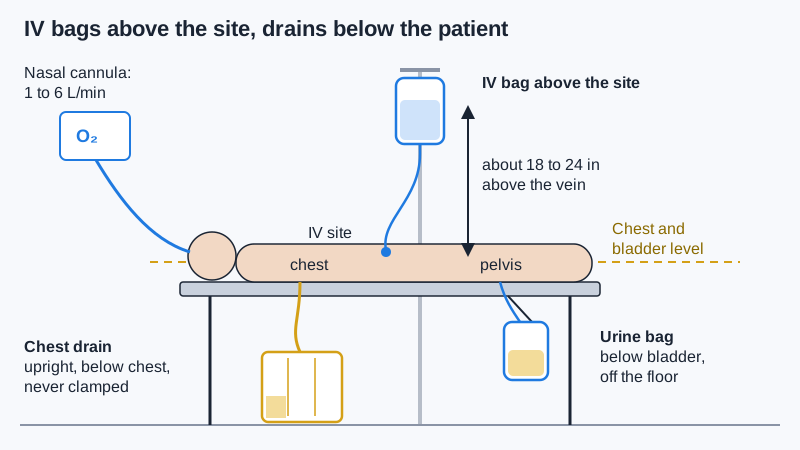
Chest tubes and lines
A chest tube drains air or fluid from the pleural space into a closed drainage unit. Keep the unit upright and below chest level so fluid cannot flow back. Never clamp the tube unless ordered. A central venous catheter has its tip in a large vein near the heart, usually the superior vena cava. A PICC enters an arm vein and is threaded to the same area. A port sits under the skin of the chest. Do not take blood pressure on an arm with a PICC. Power inject only through a line labeled power-injectable.
The numbers
A Foley urinary catheter drains into a bag that must stay below the bladder to prevent backflow and infection. Do not lay the bag on the patient's lap. Oxygen is a drug and needs an order. A nasal cannula delivers about 1 to 6 L/min. A simple mask runs about 5 to 10 L/min. A nonrebreather mask with a reservoir bag runs 10 to 15 L/min. Worked example: a patient arrives on a 2 L/min cannula. Connect to the room's wall oxygen at the same 2 L/min, not higher, unless the order changes. Check portable tank levels before transport.
Moving safely
Before a move, find every line and tube and plan where each will go. Move bags and drains with the patient, keeping IV bags above the site and drainage bags below. Leave enough slack so nothing pulls. After the move, check that each line is intact, unkinked, and still running.
Clinical Example
A post-op patient arrives on a stretcher for a chest exam with an IV, a chest tube, and a Foley. The technologist hangs the IV bag above the arm and keeps the chest drain upright on the floor. He hooks the urine bag on the table frame below the hips, then checks each line after the transfer.
Common Mistakes
- Clamping a chest tube for transport without an order.
- Laying the urine bag on the patient's abdomen during a transfer.
- Turning up the oxygen flow without an order, which can harm some COPD patients.
- Power injecting through a PICC or port that is not labeled power-injectable.
Why It Matters
The registry tests where bags and drains belong, oxygen device flow ranges, and safe handling of lines. Errors here can cause backflow, infection, or a dislodged line.
Key Relationships
- IV bag → above the IV site
- Chest drain → upright, below chest, not clamped
- Urine bag → below the bladder
- Nasal cannula 1 to 6 L/min → nonrebreather 10 to 15 L/min