
Image Production · Exposure and contrast2 min read5-question check
Technique Chart Construction
Fixed-kVp charts hold kVp and change mAs with thickness; variable-kVp charts add about 2 kVp per cm.
The rule
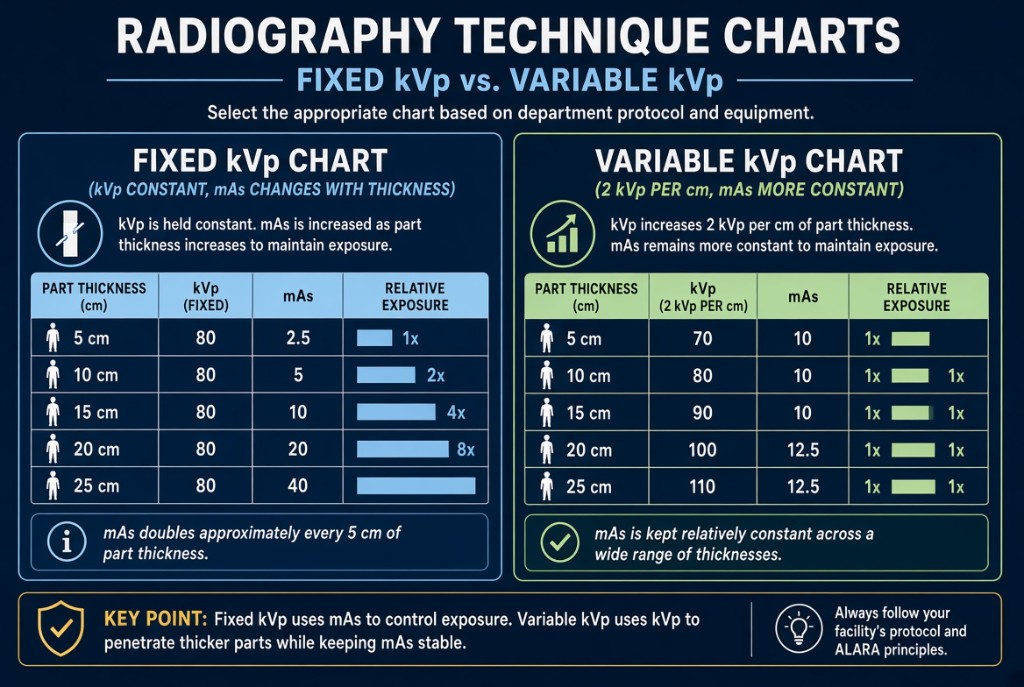
A technique chart lists exposure factors for each exam based on the measured thickness of the part. A fixed-kVp chart sets one optimal kVp for each body part and changes mAs as thickness changes. A variable-kVp chart keeps mAs constant for a part and adds about 2 kVp for every centimeter of added thickness.
Fixed vs Variable kVp Charts
Two kinds
Fixed-kVp charts group patients into thickness ranges such as small, medium, and large. The kVp is chosen high enough to penetrate the part and give adequate subject contrast. Because kVp stays the same, contrast stays consistent from patient to patient, and the higher kVp with lower mAs usually means less patient dose. Variable-kVp charts allow small, precise steps, which suits thin parts like extremities, but contrast changes as kVp changes.
The numbers
Fixed-kVp charts commonly use the rule that a 4 to 5 cm change in thickness calls for doubling or halving the mAs. If an abdomen measuring 22 cm is charted at 80 kVp and 20 mAs, a patient measuring 26 cm needs about 40 mAs at the same 80 kVp. On a variable-kVp chart, a knee charted at 60 kVp for 10 cm would need 66 kVp at 13 cm, with mAs unchanged.
On the job
Measure with calipers through the central ray, not by guessing. Every chart assumes stated conditions: SID, grid, receptor, and generator. If any of these change, the chart no longer applies as written. Adjust for pathology, casts, and contrast media, and for patients outside the chart's range. Even rooms that rely on automatic exposure control need a chart for manual exams such as mobile radiography and small extremities.
Clinical Example
A mobile abdomen is ordered on a large patient. You measure 28 cm at the central ray. The chart lists 80 kVp and 25 mAs for 24 cm, so you double to 50 mAs at 80 kVp. The exposure indicator lands in range on the first attempt.
Common Mistakes
- Estimating thickness by eye instead of measuring with calipers at the central ray.
- Using a chart written for 40 inches SID with a grid at a different SID or without the grid.
- Raising kVp on a fixed-kVp chart for a larger patient instead of increasing mAs.
- Ignoring pathology or a cast that calls for an adjustment beyond the chart.
Why It Matters
A good chart produces consistent images on the first exposure, which prevents repeats and keeps dose down. The registry tests which factor each chart type holds constant, the 2 kVp per cm rule, and mAs changes for thickness.
Key Relationships
- Fixed kVp → kVp constant, mAs varies with thickness
- Variable kVp → mAs constant, about 2 kVp per cm
- Fixed kVp: 4 to 5 cm thicker → double the mAs
- Higher kVp with lower mAs → lower patient dose