
Safety · Radiobiology2 min read5-question check
Stochastic vs Deterministic Effects
Deterministic effects have a threshold and worsen with dose; stochastic effects have no threshold.
Two kinds
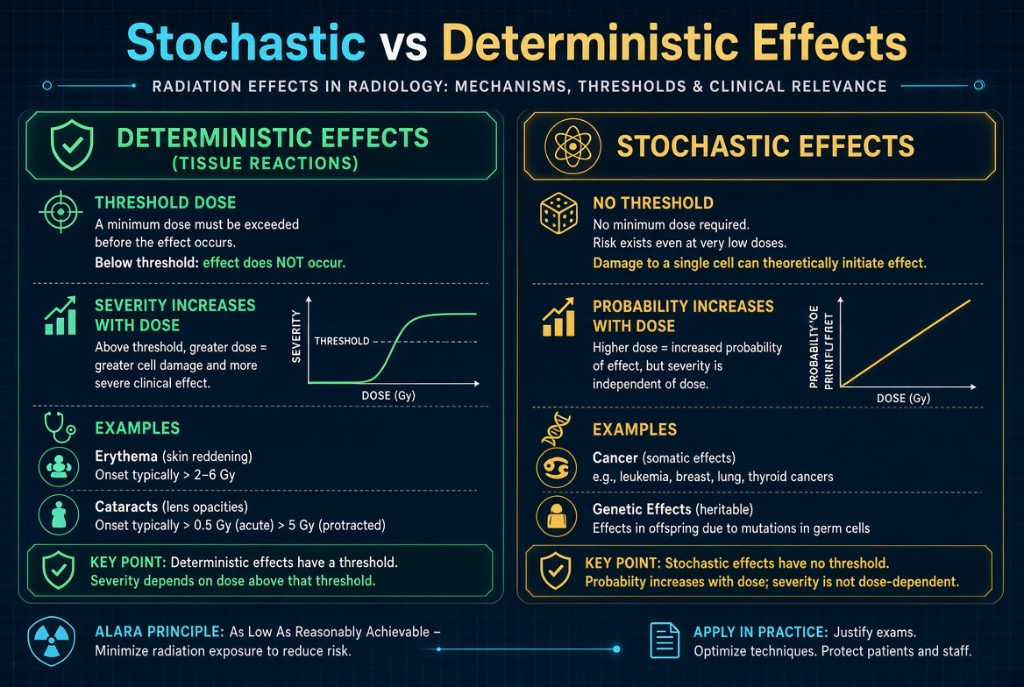
Deterministic effects, now often called tissue reactions, happen only after a dose passes a threshold. Above that threshold the effect is expected to appear, and a higher dose makes it more severe. Examples are skin erythema, epilation, cataracts, sterility, and the acute radiation syndromes. Stochastic effects are random. They have no threshold, so any dose carries some risk, and a higher dose raises the chance the effect occurs, not its severity. Cancer, including leukemia, and hereditary genetic effects are stochastic.
Stochastic vs deterministic effects
Why it happens
Deterministic effects come from killing many cells in a tissue. Lose enough cells and the organ shows damage; lose more and the damage is worse. Stochastic effects can start from damage to the DNA of a single cell that survives, then later becomes malignant or passes a mutation to offspring. A cancer caused by a small dose is no milder than one caused by a large dose.
The numbers
Deterministic effects follow a nonlinear threshold dose-response curve. Transient skin erythema begins at about 2 Gy, and in 2011 the ICRP lowered the cataract threshold to about 0.5 Gy. Stochastic risk is modeled with the linear no-threshold, or LNT, model: risk rises in direct proportion to dose, all the way down to zero dose. Worked example: under LNT, doubling the dose doubles the estimated risk. Absorbed dose in gray describes tissue reactions; effective dose in sievert estimates stochastic risk.
On the job
Routine radiographs deliver skin doses far below deterministic thresholds. Long fluoroscopy-guided procedures are the exception, where skin injury is possible. For every exam, the LNT model is the reason for ALARA.
Clinical Example
Two weeks after a long fluoroscopically guided procedure, a patient develops reddened skin on the back. That is a deterministic effect: the skin dose crossed the threshold. The same patient's small added cancer risk is stochastic and cannot be predicted for any one person.
Common Mistakes
- Saying a larger dose makes a radiation-induced cancer more severe, when it only makes it more likely.
- Classifying cataracts as stochastic, when they are deterministic with a threshold.
- Believing a very small dose carries zero cancer risk, when LNT assumes some risk at any dose.
- Matching the wrong curve: tissue reactions use a threshold curve, stochastic effects use linear no-threshold.
Why It Matters
This distinction explains why diagnostic exams do not burn skin yet still require ALARA. The registry asks you to classify effects and match each one to its dose-response model.
Key Relationships
- Deterministic: threshold, severity ↑ with dose
- Stochastic: no threshold, probability ↑ with dose
- Cancer, leukemia, hereditary effects → stochastic
- Erythema, epilation, cataracts, sterility → deterministic
- LNT: doubling dose doubles estimated risk