
Image Production · Geometry and detail2 min read5-question check
Spatial Resolution vs Contrast Resolution
Spatial resolution shows fine detail; contrast resolution separates similar tissues. Each has its own test.
Two kinds
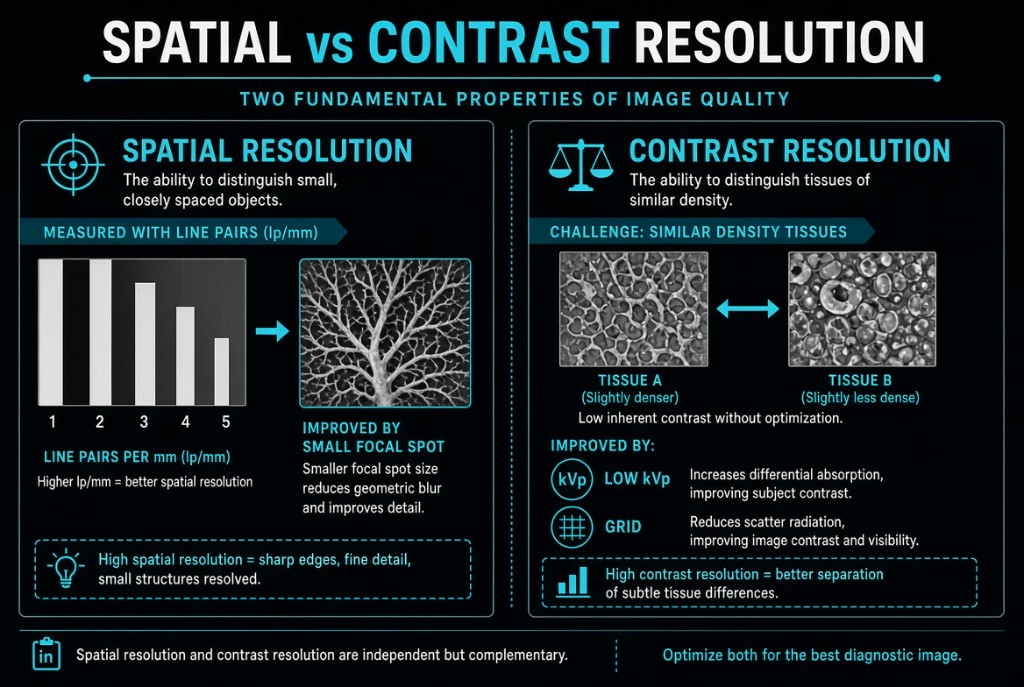
Spatial resolution is the ability to show small objects and sharp edges as separate, distinct details. Contrast resolution is the ability to tell apart structures with only a small difference in attenuation, such as two soft tissues of similar density. A system can be strong in one and weak in the other, so the registry treats them as different qualities.
Spatial vs Contrast Resolution
How they are measured
Spatial resolution is measured in line pairs per millimeter, or lp/mm. A test pattern of lead bars and spaces gets finer and finer, and the highest frequency still seen as separate lines is the limit. More lp/mm means better spatial resolution. Contrast resolution is measured by low-contrast detectability. A contrast-detail phantom holds objects of decreasing size and decreasing contrast, and the faintest object you can still see shows the system's contrast resolution.
MTF and DQE
The modulation transfer function, or MTF, describes how well a system carries object contrast into the image at each spatial frequency. An MTF of 1 means perfect transfer. MTF always drops as detail gets finer, so a system whose MTF stays higher at high frequencies has better spatial resolution. Detective quantum efficiency, or DQE, describes how efficiently the detector turns incoming x-rays into useful signal. A detector with high DQE makes a less noisy image at the same dose, which supports contrast resolution and dose reduction.
The trade-offs
The two often pull against each other. Smaller pixels or detector elements improve spatial resolution, but each one collects fewer photons, so noise rises and contrast resolution can suffer unless dose goes up. Noise is the main enemy of contrast resolution, so anything that raises the signal-to-noise ratio helps it. Scatter also lowers contrast resolution, which is why collimation and grids matter. For passing context, CT has better contrast resolution than radiography, while radiography has better spatial resolution.
Clinical Example
A detector looks sharp on a bar-pattern test but struggles to show a faint lung nodule. Its spatial resolution is good, but noise limits low-contrast detectability. A higher-DQE detector would show the nodule better without adding dose.
Common Mistakes
- Using lp/mm to describe contrast resolution.
- Assuming smaller pixels improve every aspect of image quality.
- Confusing MTF, which relates to detail transfer, with DQE, which relates to detector efficiency.
- Forgetting that noise, not sharpness, limits low-contrast detail.
Why It Matters
Choosing equipment and technique means balancing detail, noise, and dose. Expect registry questions that ask which measurement or term matches each type of resolution.
Key Relationships
- Spatial resolution → lp/mm, higher is better
- Contrast resolution → low-contrast detectability
- Higher DQE → less noise at the same dose
- Smaller pixels → better spatial resolution but more noise per pixel
- More noise or scatter → worse contrast resolution