
Safety · Radiation protection and dose2 min read5-question check
Radiation Units and Dose Limits
Gy measures energy absorbed; Sv measures risk. Workers get 50 mSv a year and 10 mSv times age over a lifetime.
The quantities
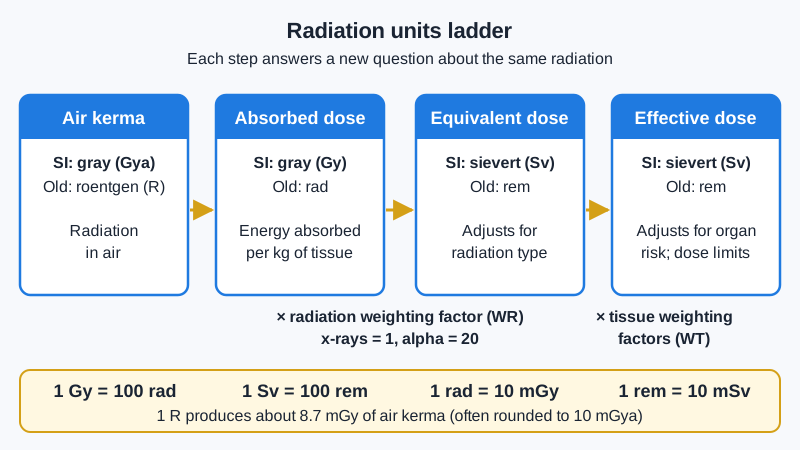
Each radiation quantity answers a different question. Air kerma, in gray (Gya), describes radiation in air, such as at the tube output or the skin entrance point. Absorbed dose, in gray (Gy), is the energy deposited per kilogram of tissue. Equivalent dose, in sievert (Sv), multiplies absorbed dose by a radiation weighting factor that accounts for the type of radiation. Effective dose, also in sievert, adds tissue weighting factors so that a partial-body exposure can be compared by overall risk.
Radiation units ladder
Old and new units
Traditional units still show up on the exam. Exposure in air was measured in roentgens (R). Absorbed dose was the rad, and dose equivalent was the rem. The conversions are simple: 1 Gy equals 100 rad, and 1 Sv equals 100 rem. So 1 rad equals 10 mGy, and 1 rem equals 10 mSv. For x-rays the radiation weighting factor is 1, so 1 Gy of absorbed dose gives 1 Sv of equivalent dose. Alpha particles carry a factor of 20.
The numbers
The registry uses the NCRP limits first set in Report 116. Occupational effective dose is 50 mSv per year. The cumulative limit is 10 mSv times age in years, so a 30-year-old technologist's lifetime limit is 300 mSv. The public limit is 1 mSv per year for frequent exposure. After a worker declares pregnancy, the embryo-fetus limit is 0.5 mSv per month. Workers' skin, hands and feet are limited to 500 mSv per year. The lens of the eye is 150 mSv per year in NCRP 116 and in federal rules. NCRP Commentary 26 (2016) and Report 180 lowered the recommendation to 50 mGy per year, so know both. Students under 18 in training are limited to 1 mSv effective dose per year.
On the job
Limits are ceilings, not targets. Most radiographers receive only a small fraction of 1 mSv per year. Dose limits cover occupational and public exposure. They exclude natural background and your own medical exams, and they do not apply to patients. Patient protection comes from justifying each exam and keeping dose as low as reasonably achievable.
Clinical Example
A 24-year-old radiographer asks how close she is to her lifetime limit. Her cumulative limit is 24 times 10 mSv, or 240 mSv. Her badge history shows 1.2 mSv total, only half a percent of that.
Common Mistakes
- Applying occupational dose limits to patients.
- Mixing up gray and sievert, or forgetting that 1 rem equals 10 mSv.
- Using 1 mSv per month instead of 0.5 mSv per month for the embryo-fetus.
- Multiplying age by 50 mSv instead of 10 mSv for the cumulative limit.
Why It Matters
Unit conversions and NCRP limits are classic registry recall items. Expect questions that ask for a cumulative limit from an age or a conversion from rad or rem.
Key Relationships
- Absorbed dose × radiation weighting factor → equivalent dose
- Equivalent dose × tissue weighting factors → effective dose
- Age × 10 mSv → cumulative occupational limit
- Declared pregnancy → 0.5 mSv per month to the embryo-fetus