
Patient Care · Ethics, law and communication2 min read5-question check
Patient Privacy, Ethics, and Cultural Competence
Share only what care requires, protect dignity, and adapt to each patient's culture without assumptions.
The rule
HIPAA, the Health Insurance Portability and Accountability Act, protects a patient's protected health information, called PHI. PHI is anything that links a person to their health: a name with a diagnosis, images, birth date, medical record number, even a photo of a requisition. Without the patient's authorization, use and share it for treatment, payment, and health care operations, and access only the minimum necessary for your job. Patients have the right to see their own records. A breach, such as images sent to the wrong person, must be reported through your facility's privacy process, not hidden.
Respect every patient
Ethics
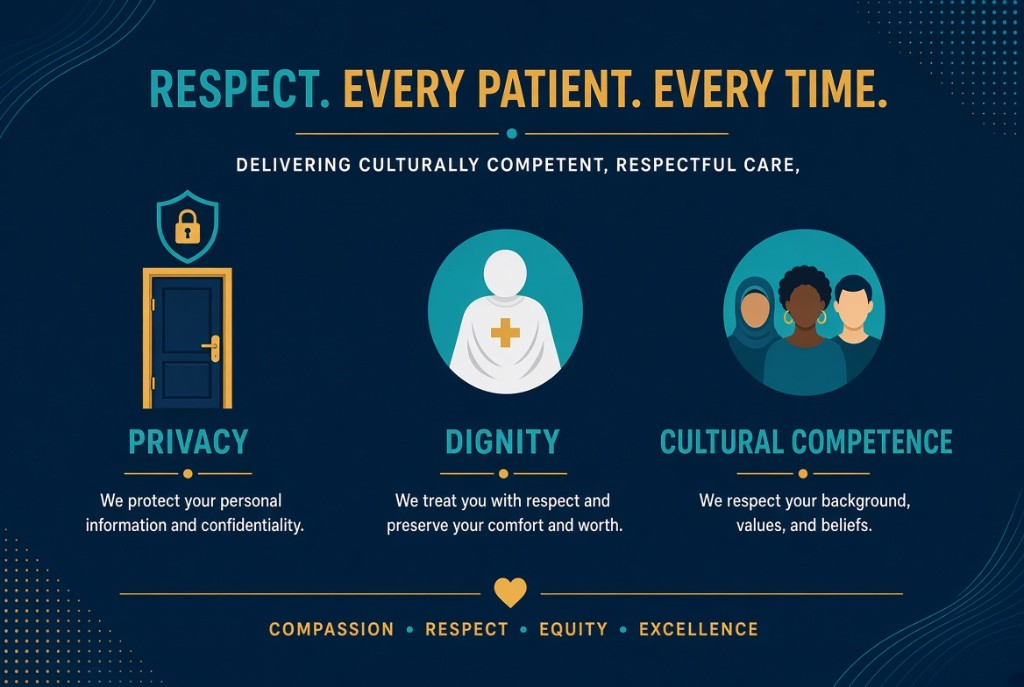
The ARRT Standards of Ethics contain a Code of Ethics, which describes ideal professional conduct, and Rules of Ethics, which are enforceable and can lead to sanctions against your credential. A few principles guide daily decisions. Autonomy is the patient's right to decide, including the right to refuse an exam. Beneficence means doing good, and nonmaleficence means avoiding harm. Justice means fair care for every patient. Veracity means telling the truth. Respect also means draping the patient, closing the door or curtain, and exposing only the part being imaged.
Cultural competence
Cultural competence means recognizing that beliefs about modesty, touch, eye contact, and family decision making differ, and adapting without stereotyping. Ask rather than assume. Honor a request for a same-gender radiographer or a chaperone when one is available. When there is a language barrier, use a qualified medical interpreter rather than a family member, and never rely on a child to interpret.
Clinical Example
Waiting for an elevator, you hear two coworkers discussing a patient's diagnosis by name. You ask them to stop, because the conversation discloses PHI in a public area. Later, a patient asks for a female radiographer for her pelvis exam; one is free, so you arrange it and drape her carefully.
Common Mistakes
- Discussing patients in elevators, hallways, or cafeterias.
- Leaving images or schedules on a monitor that visitors can see.
- Using a patient's child as an interpreter.
- Pressuring a patient who refuses an exam instead of respecting the refusal and reporting it.
Why It Matters
Privacy breaches harm patients and carry legal penalties, and ethics violations can cost you your ARRT credential. Registry questions test the minimum necessary standard, ethical principles by name, and appropriate interpreter use.
Key Relationships
- Without authorization, PHI is used for treatment, payment, or operations, and only the minimum necessary
- Code of Ethics = aspirational; Rules of Ethics = enforceable
- Autonomy = the right to choose and to refuse
- Beneficence = do good; nonmaleficence = do no harm
- Language barrier → qualified medical interpreter, not family