
Safety · Radiation physics2 min read5-question check
Photon Interactions with Matter
Photoelectric absorption builds contrast and patient dose; Compton scatter fogs the image and exposes staff.
The rule
As the beam passes through the patient, each photon is absorbed, scattered, or transmitted to the receptor. The difference in absorption between tissues, called differential absorption, creates the image. In the diagnostic range three interactions matter: photoelectric absorption, Compton scattering, and coherent scattering. Pair production needs at least 1.02 MeV and photodisintegration needs even more, so neither occurs at diagnostic energies.
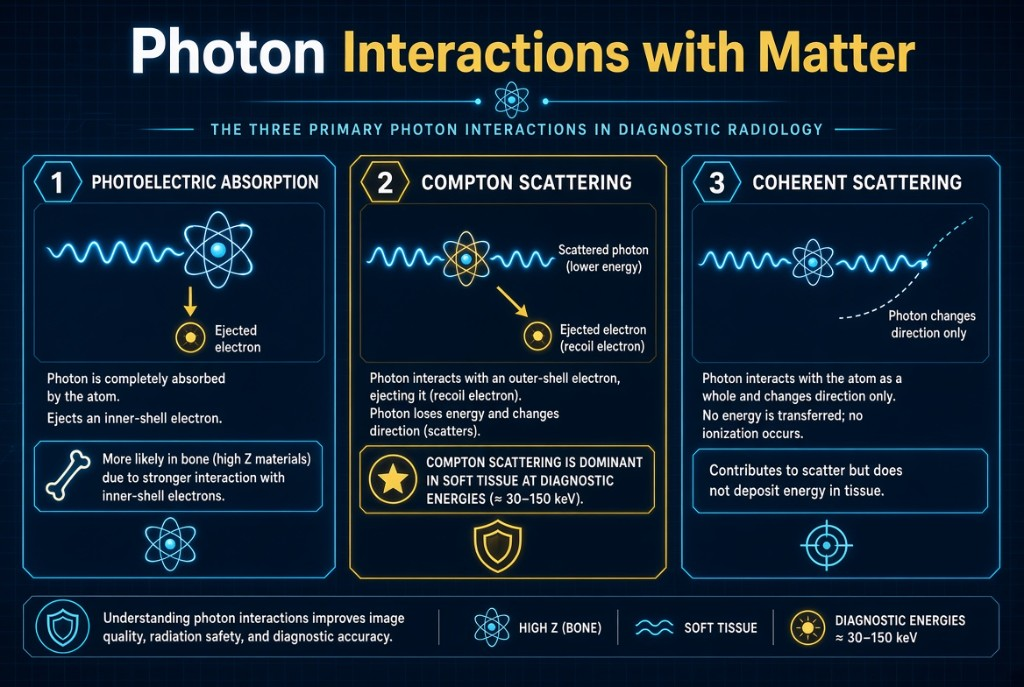
Photon interactions with matter
How it works
In photoelectric absorption, the photon ejects an inner-shell electron and is absorbed completely. In soft tissue, the ejected photoelectron and the weak characteristic photon that follows are absorbed locally, so this interaction adds patient dose but no scatter. In Compton scattering, the photon ejects an outer-shell electron, called the recoil or Compton electron, then continues in a new direction with less energy. That scattered photon can reach the receptor as fog or leave the patient and expose staff. In coherent scattering, a low-energy photon changes direction without losing energy or ionizing the atom; it adds only a little fog.
The numbers
Photoelectric probability rises steeply with atomic number, roughly as Z cubed, and falls steeply with photon energy, roughly as one over energy cubed. Worked example: a material with twice the atomic number has about 2 × 2 × 2, or 8 times, the photoelectric absorption. That is why bone, iodine, and barium appear bright. Compton probability does not depend on atomic number. As kVp rises, both interactions become less likely, but photoelectric drops faster, so Compton becomes a larger share and contrast falls. Compton is the dominant interaction in soft tissue across most of the diagnostic range.
Clinical Example
A chest is imaged at 120 kVp. Most photons that interact in the soft tissue undergo Compton scattering, so a grid and tight collimation are used to protect contrast. The ribs look less distinct than at 70 kVp because photoelectric absorption in bone drops at higher energy.
Common Mistakes
- Calling photoelectric absorption a source of scatter, when the photon is absorbed completely.
- Thinking Compton depends on atomic number, when it is essentially independent of Z.
- Assuming coherent scattering ionizes tissue, when it only changes the photon's direction.
- Forgetting that higher kVp lowers contrast because photoelectric absorption falls faster than Compton.
Why It Matters
Photoelectric absorption creates contrast but deposits patient dose, while Compton scatter degrades contrast and is the main source of occupational exposure. The registry tests which interaction does what and how kVp shifts the balance.
Key Relationships
- Photoelectric ∝ Z³ and ∝ 1/E³
- Double Z → about 8 times the photoelectric absorption
- Compton is independent of Z and is the main source of scatter and staff dose
- kVp ↑ → larger Compton share → lower contrast
- Pair production needs at least 1.02 MeV, so it is not diagnostic