
Patient Care · Assistance, monitoring and emergencies2 min read5-question check
Pediatric immobilization
Devices before people, the shortest exposure time, and no holder ever in the primary beam.
The rule
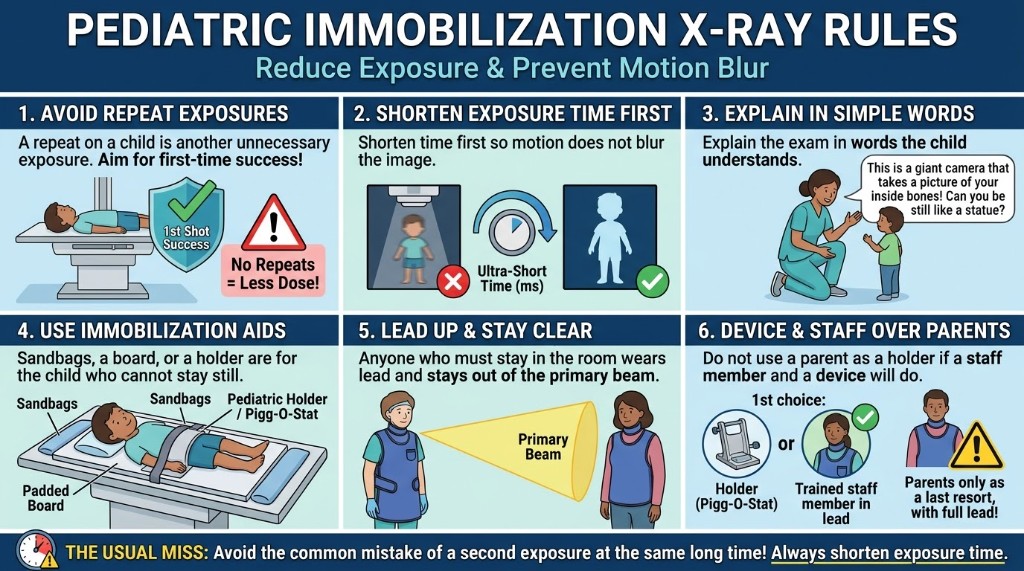
Motion is the most common reason a pediatric image is repeated, and every repeat adds a full exposure for that view. Children are more radiosensitive than adults and have more years for late effects to appear. The goal is one good exposure: a still child, a tight field, and the shortest exposure time the equipment allows.
How it works
Start with communication. Explain each step in simple words, show the child the equipment, and let them see the light field before the exposure. Distraction and a calm, confident voice help. When words are not enough, use mechanical immobilization: a sheet or blanket wrap, sandbags, sponges, tape over padding, compression bands, or a dedicated device such as a Pigg-O-Stat for an upright infant chest or abdomen. On the technique side, use a high mA so the exposure time can be as short as possible.
Who holds
If a person must hold the child, use a parent or guardian who is not pregnant and is not a minor. Radiographers and other occupationally exposed staff should never be routine holders, because their dose adds up over a career. The holder wears a lead apron and lead gloves, stays out of the primary beam, and keeps hands outside the collimated field.
On the job
Get everything ready before the child is positioned: technique set, receptor in place, field collimated, devices within reach. The less time a child spends waiting on the table, the less chance of motion. Watch the child, not the console, and expose at the moment of stillness.
Clinical Example
A 2-year-old needs an upright chest radiograph and will not sit still. You place him in a Pigg-O-Stat, set a high mA with a short time, and let his mother stand behind the protective barrier talking to him. He stops crying for a moment on inspiration, and you expose.
Common Mistakes
- Repeating a blurred image with the same long exposure time instead of shortening it first.
- Having a radiographer hold the child when a device or a parent could be used.
- Letting a holder's gloved hand drift into the primary beam.
- Positioning the child first and then setting technique, which adds waiting time and motion.
Why It Matters
Good immobilization prevents repeats, which is the simplest pediatric dose reduction there is. The registry tests who may hold, what the holder wears, and which technique change reduces motion.
Key Relationships
- Shorter exposure time → less motion blur
- Devices first, then a nonoccupational holder, never staff as routine
- Holder: apron and gloves, out of the primary beam
- Every repeat → another full exposure