
Patient Care · Assistance, monitoring and emergencies2 min read5-question check
Pediatric and Geriatric Considerations
Children need the lowest dose and honest, simple talk; older adults need time, support, and gentle handling.
The rule
Patients at both ends of life need the exam adapted to them. Children are more sensitive to radiation and less able to hold still. Older adults may be frail, slow to move, hard of hearing, or confused. The anatomy and the images you need stay the same, but your technique, communication, and immobilization change.
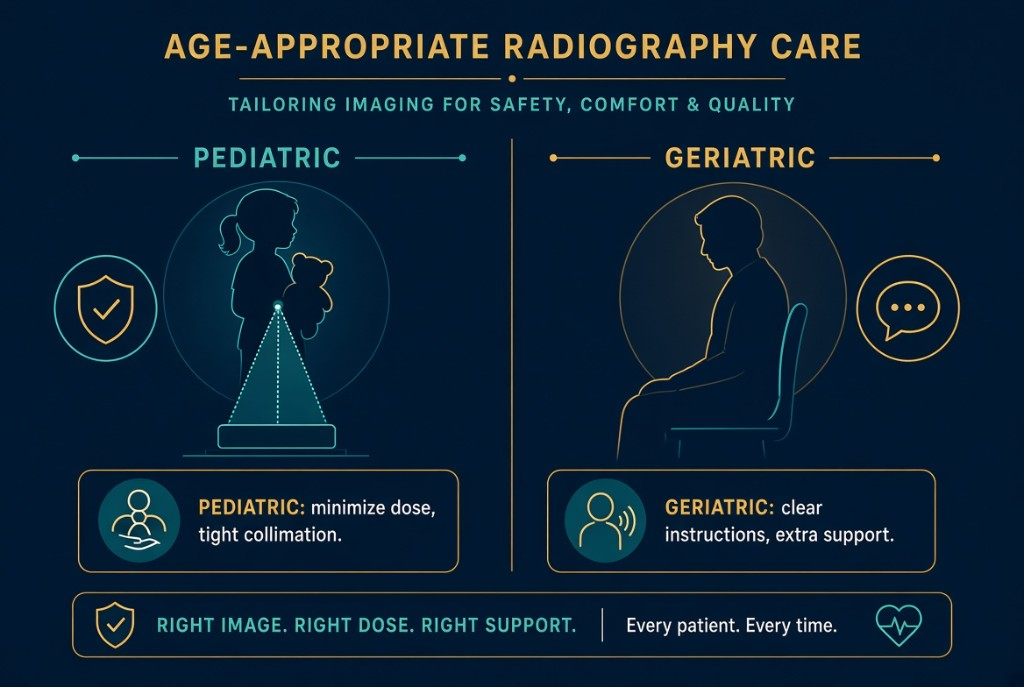
Age-appropriate radiography care
Children
Children's rapidly dividing cells are more radiosensitive, and children have many years ahead for a radiation-induced cancer to appear. Use pediatric protocols with lower exposure factors, the shortest practical exposure time to stop motion, and tight collimation. A grid is usually not needed for parts under about 10 cm thick. Explain the exam honestly in words the child understands. Use immobilization devices such as a Pigg-O-Stat for an erect infant chest, or a sheet wrap. If someone must hold the child, it should be a parent who is not pregnant, wearing a lead apron and gloves. Radiographers should not routinely hold patients. The Image Gently campaign promotes child-sized technique.
Older adults
Aging brings thin, fragile skin, so avoid tape directly on skin and move patients by lifting with help, not dragging. Osteoporosis makes bone less dense, so technique may need to be reduced. Kyphosis and arthritis may make standard positions impossible; support the patient with sponges and angle the tube or receptor instead of forcing the body. Face the patient and speak slowly and clearly without shouting. Older patients chill easily and fall easily, so keep them covered and never leave them alone on the table. Use their name, not pet names.
Clinical Example
An 86-year-old man with severe kyphosis cannot lie flat for a thoracic spine exam. Rather than pressing his shoulders down, you support him with sponges and adjust the central ray to match his curve. You face him while giving instructions and help him off the table with a step stool and a firm hold.
Common Mistakes
- Using adult exposure factors on a child instead of a pediatric protocol.
- Having a radiographer routinely hold patients instead of using devices or a nonpregnant caregiver.
- Shouting at an older patient rather than facing them and speaking clearly.
- Tearing fragile skin by taping it or pulling the patient across the table.
Why It Matters
Children carry the greatest lifetime cancer risk per unit of dose, and older adults carry the greatest risk of falls and skin injury. Registry questions ask who should hold a patient, why children need lower dose, and how to adapt positioning.
Key Relationships
- Younger patient → more radiosensitive → lowest dose that answers the question
- Shorter exposure time → less motion blur in children
- Holder = nonpregnant caregiver in lead apron and gloves, not staff
- Osteoporosis → less dense bone → technique may be reduced
- Kyphosis → adapt with sponges and angles, never force