
Patient Care · Assistance, monitoring and emergencies2 min read5-question check
Patient Transfer and Body Mechanics
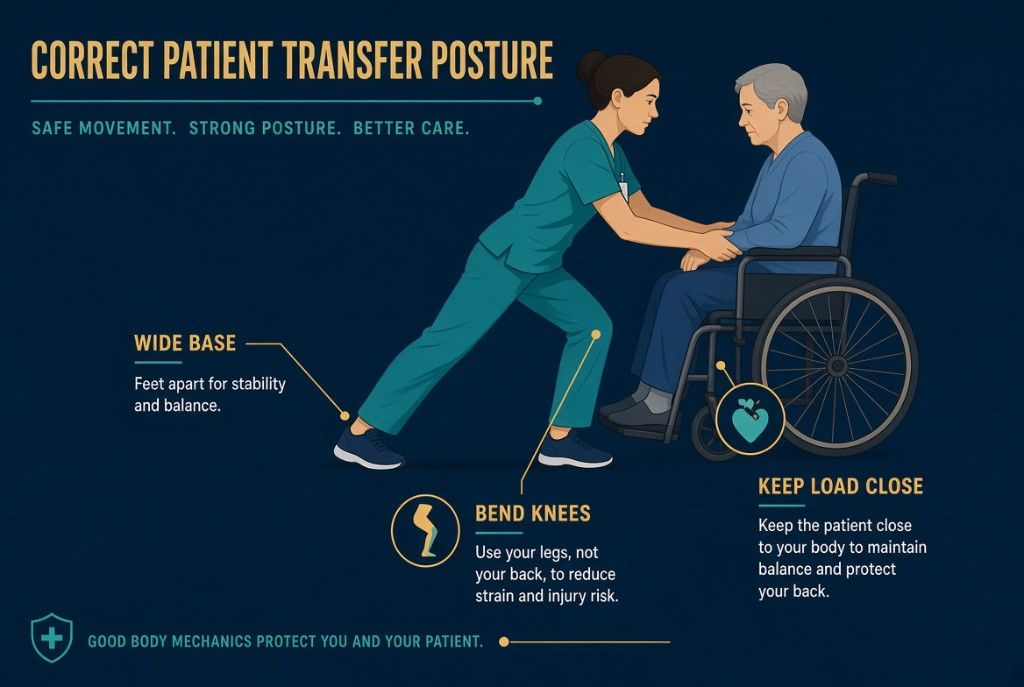
Wide base, bent knees, load close, no twisting, and wheels locked before every transfer.
The rule
Good body mechanics protect your back and keep the patient from falling. Stand with your feet apart for a wide base of support. Bend at the knees and hips, not the waist, and lift with your leg muscles. Keep the load close to your body. Turn by pivoting your feet rather than twisting your spine, and push or slide rather than pull or lift when you can.
Correct patient transfer posture
Why it works
Your center of gravity sits in the pelvis. A wide base and a load held close keep that center over your feet, so you stay stable. Holding weight away from the body multiplies the strain on your lower back, and twisting while lifting is a common cause of back injury in health care workers. The leg muscles are larger and stronger than the back muscles, so they should do the work.
Wheelchair transfers
Before any move, assess the patient. Ask how well they can stand and bear weight, and check for IV lines, oxygen tubing, and catheters. Lock the wheelchair wheels and move the footrests out of the way. Place the chair close to the table, and if one side is weak, as after a stroke, have the patient move toward the stronger side. Use a transfer belt for support. Let the patient sit up for a moment before standing to avoid dizziness from orthostatic hypotension. A step stool with a handle helps the patient reach the table.
Stretcher transfers
For a patient who cannot help, use a stretcher transfer with a slide board or draw sheet and enough trained staff for the patient's size and condition. A fully dependent patient usually needs several people. Lock the stretcher wheels and bring it level with the table. Keep IV bags above the infusion site and urinary drainage bags below the bladder. Never leave a patient alone on the table, and lift the side rails once they are back on the stretcher.
Clinical Example
A patient with right-sided weakness after a stroke arrives by wheelchair. The radiographer locks the wheels, positions the chair so the patient moves toward the left side, applies a transfer belt, and lets the patient sit a moment before standing and pivoting to the table.
Common Mistakes
- Bending at the waist or twisting while lifting.
- Forgetting to lock the wheelchair or stretcher wheels.
- Pulling the patient up by the arms.
- Attempting a dependent transfer alone instead of getting help.
Why It Matters
Falls injure patients and back strain ends careers. Registry questions focus on body mechanics, locking wheels, and moving toward the strong side.
Key Relationships
- Wide base + load close → stable center of gravity
- Bend knees, lift with legs → less back strain
- Weak side → patient moves toward the strong side
- IV bag above the site, drainage bag below the bladder