
Patient Care · Ethics, law and communication2 min read5-question check
Patient Identification and Verification
Before any exposure, match two identifiers from the patient to the wristband and the order.
The rule
Every exam starts with confirming you have the right patient for the right exam. The standard is at least two patient identifiers, such as full name and date of birth, or name and medical record number. A room number or bed location is never an identifier, because patients move and rooms are reused.
Match before exposure
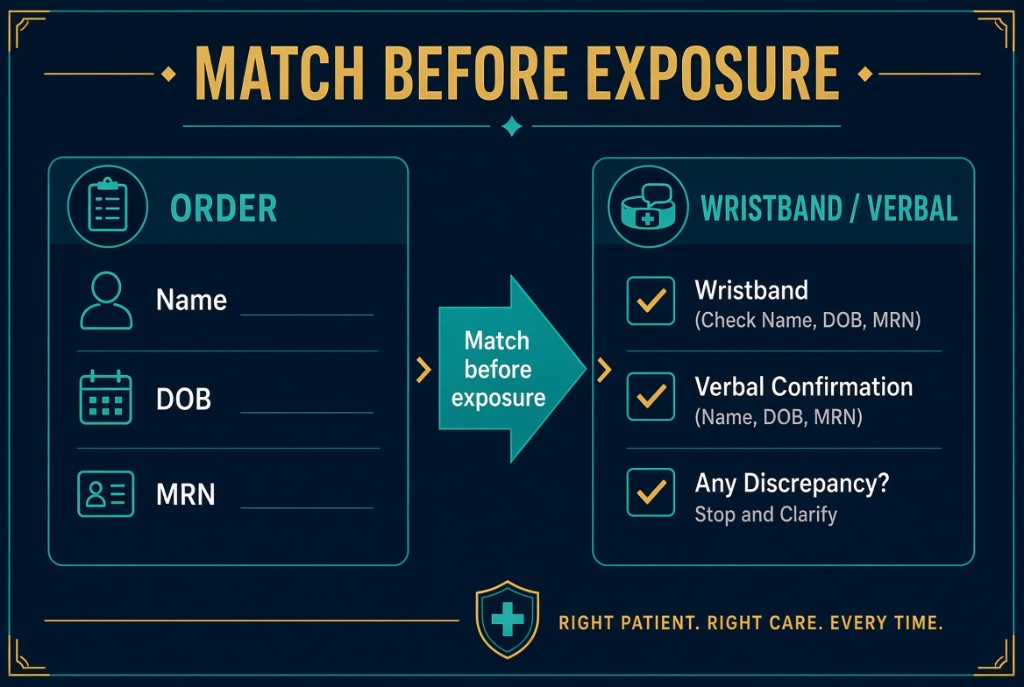
How it works
Ask open-ended questions. Say, please tell me your full name and date of birth, rather than asking, are you Mary Jones? A confused, anxious, or hard-of-hearing patient may simply say yes to any name. Compare what the patient says with the wristband and with the order. Then confirm the exam itself: the correct body part, the correct side, and that the request makes sense for the patient's history. Verify identity again before giving contrast or any medication.
Special cases
Some patients cannot answer for themselves. For an unconscious or sedated patient, rely on the wristband and confirm with the nurse caring for the patient. For a young child, ask the parent or guardian to state the identifiers. For an unidentified trauma patient, the facility assigns a temporary name and number, and that same identity must be used on every image until it is merged with the real record. Use a qualified interpreter when there is a language barrier.
If something is wrong
If the wristband is missing or does not match, stop and do not image until the problem is fixed by nursing or registration. If you discover after the exam that images went to the wrong record, report it right away through your facility's process so the images can be corrected in PACS and the radiologist and ordering provider are informed. Never fix it quietly yourself. A wrong-patient error is also a reportable quality event.
Clinical Example
A radiographer arrives for a portable chest and the patient in bed 4 answers yes to the name on the order. She then asks him to state his name and date of birth, and he gives a different birth date. The wristband confirms he is a different patient, and the correct patient had been moved to another room.
Common Mistakes
- Using the room or bed number as an identifier.
- Asking a yes-or-no question instead of having the patient state identifiers.
- Skipping the wristband check because the patient is already on the table.
- Assuming identity was already verified by transport or another radiographer.
Why It Matters
Wrong-patient exams expose people to radiation they did not need and can lead to wrong treatment. The registry tests acceptable identifiers and the correct response to a mismatch.
Key Relationships
- At least two identifiers → before every exam
- Room number → never an identifier
- Open-ended question → more reliable than yes or no
- Mismatch → stop and correct before imaging