
Image Production · Geometry and detail2 min read5-question check
Motion blur
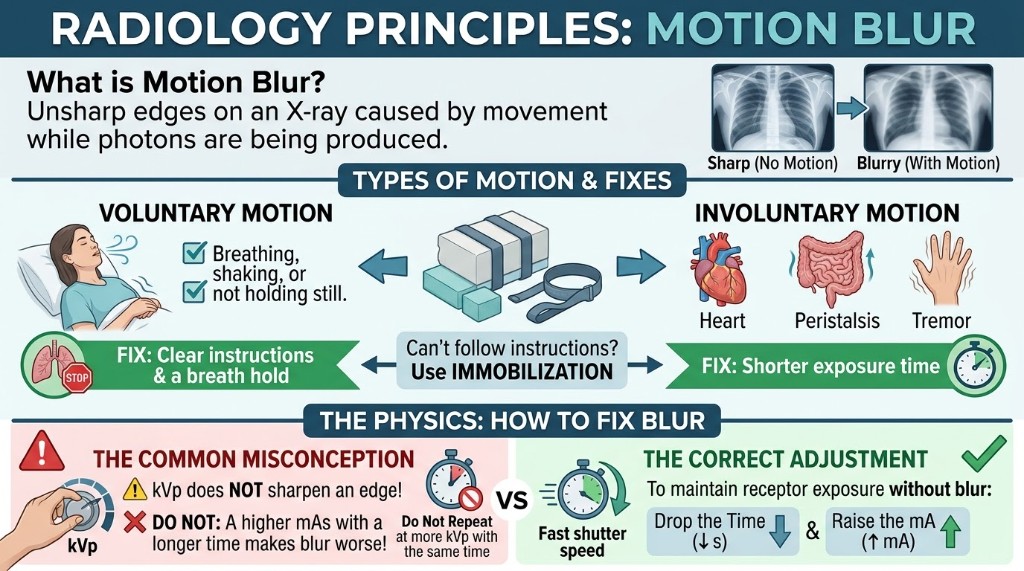
Motion blur is controlled by a short exposure time, clear instructions, and immobilization, never by kVp.
The rule
Motion blur is unsharpness caused by movement of the patient, the part, or the equipment during the exposure. It is one of the most common causes of lost spatial resolution, and no post-processing can remove it. There are two controls: reduce the chance of movement, and make the exposure time short enough that any movement does not register.
Two kinds
Voluntary motion is movement the patient can control, such as breathing or shifting position. Control it with clear instructions, a practiced breath hold, comfort, and immobilization devices such as sponges, sandbags, and straps. Involuntary motion is movement the patient cannot control, such as the heartbeat, peristalsis, tremors, or spasms. Only a shorter exposure time reduces it. On the image, voluntary motion usually blurs everything, while involuntary motion blurs one area, such as bowel gas, while nearby bones stay sharp.
The numbers
mAs equals mA times time. To shorten time without changing receptor exposure, raise mA by the same factor. Worked example: an abdomen needs 20 mAs. At 200 mA the time is 0.1 second. At 400 mA the time is 0.05 second, still 20 mAs, with half the window for motion. A higher mA may require the large focal spot, which costs a little geometric sharpness, but for a patient who cannot hold still that trade is worth it.
On the job
Raising kVp does not sharpen moving edges. It changes exposure and contrast, and if time stays the same, the blur stays too. Sometimes motion is used on purpose. A breathing technique for a lateral thoracic spine uses low mA and a long time while the patient breathes gently, blurring the ribs and lung markings so the vertebrae show more clearly.
Clinical Example
An anxious patient keeps shifting during a PA hand. You explain again, rest the hand flat on the receptor, place a sandbag across the forearm, and choose the highest practical mA so the time is as short as possible. You watch the hand and expose only when it is still.
Common Mistakes
- Raising kVp to fix blur while leaving the exposure time unchanged.
- Relying on a breath hold to stop heart motion, which only a short time controls.
- Raising mAs by lengthening time, which gives more opportunity for motion.
- Exposing before the patient has finished the breathing instruction and is truly still.
Why It Matters
Motion is a leading cause of repeats, and each repeat adds dose for that view. The registry asks you to tell voluntary from involuntary motion and to pick the factor that reduces blur.
Key Relationships
- Shorter time → less motion blur
- mAs = mA × time; double mA, halve time, same exposure
- Voluntary motion → instructions, breath hold, immobilization
- Involuntary motion → shortest possible time
- kVp → no effect on motion blur