
Safety · Radiation protection and dose2 min read5-question check
Minimum Source-to-Skin Distance (SSD)
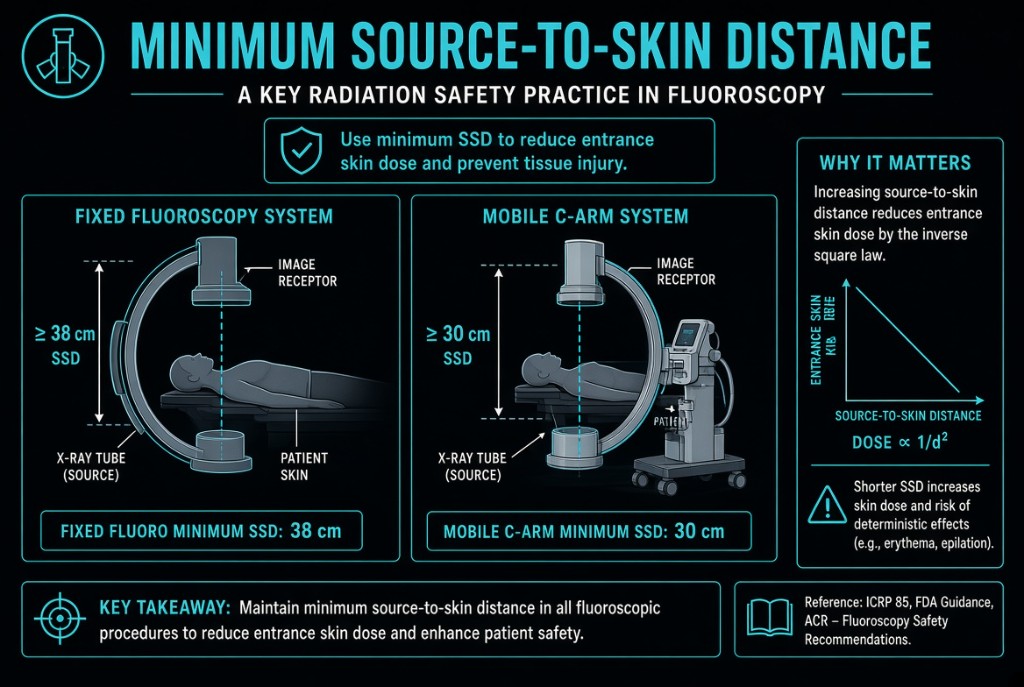
Fluoroscopy needs at least 38 cm SSD on fixed units and 30 cm on mobile C-arms to limit skin dose.
The rule
Source-to-skin distance, or SSD, is the distance from the x-ray tube focal spot to the patient's skin where the beam enters. Federal regulations set a minimum SSD for fluoroscopy. Fixed fluoroscopic units must keep the tube at least 38 cm, about 15 inches, from the skin. Mobile fluoroscopic units, such as C-arms, must keep at least 30 cm, about 12 inches.
Minimum Source-to-Skin Distance
Why it happens
The beam spreads out as it leaves the tube, so its intensity follows the inverse square law. Skin close to the source sits where the beam is most concentrated and receives a much higher dose rate. Fluoroscopy can run for many minutes, so a short SSD can push skin dose high enough to cause injury such as erythema. The minimum SSD rule keeps the entrance surface out of that most intense zone.
The numbers
Use the inverse square law to see the effect. If the skin moves from 38 cm to 19 cm from the source, the distance is halved, so intensity rises by a factor of four. Going the other way, moving from 30 cm to 60 cm cuts the intensity at the skin to one fourth. Small changes close to the tube make big differences in dose.
On the job
Fixed fluoroscopy rooms are built so the tube under the table cannot get closer than the minimum. Mobile C-arms usually have a spacer cone or similar device on the tube housing to hold the 30 cm distance, and it should never be removed. With a C-arm, place the tube under the patient and keep the image receptor as close to the patient as possible. This keeps the tube farther from the skin, lowers the output the system needs, and reduces magnification. If the surgeon needs a larger image, use the electronic magnification mode or digital zoom instead of moving the tube toward the patient. Magnification mode raises the dose rate somewhat, but it does not break the SSD limit.
Clinical Example
During a hip pinning, the surgeon asks for a bigger image and someone starts raising the C-arm tube toward the patient. The radiographer instead keeps the tube at or beyond 30 cm with the spacer in place, keeps the image receptor close to the hip, and selects magnification mode.
Common Mistakes
- Swapping the limits: 38 cm is for fixed units and 30 cm is for mobile units.
- Removing the C-arm spacer cone to gain working room.
- Moving the tube toward the patient instead of moving the receptor closer.
- Placing the C-arm tube over the patient, which raises dose to the operator's upper body.
Why It Matters
SSD limits protect the patient from high skin dose during long fluoroscopic procedures. The registry asks for the exact numbers and for the best C-arm setup.
Key Relationships
- Fixed fluoroscopy minimum SSD = 38 cm, about 15 inches
- Mobile fluoroscopy minimum SSD = 30 cm, about 12 inches
- Halve the distance → intensity rises 4 times
- Receptor close to patient, tube under patient → lower skin dose