
Image production2 min read5-question check
Inverse square law
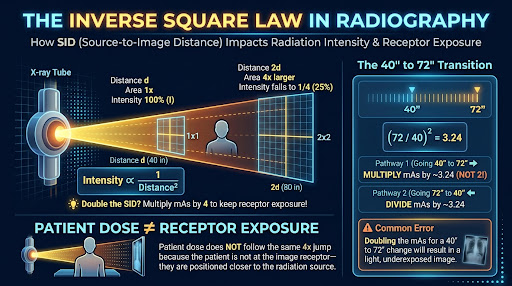
Double the distance and beam intensity drops to one fourth; triple it and it drops to one ninth.
The rule
The intensity of the x-ray beam is inversely proportional to the square of the distance from the source. As a formula, I1 divided by I2 equals D2 squared divided by D1 squared. Double the distance and intensity falls to one fourth. Triple it and intensity falls to one ninth.
Why it happens
X-rays leave the focal spot in straight lines and spread out like light from a bare bulb. The tube puts out the same number of photons wherever the receptor sits, but at twice the distance those photons cover four times the area. Each square centimeter of the receptor, or of your body, now receives one fourth as many photons. Air absorbs very little of the beam. It simply spreads thinner.
The numbers
Suppose a survey meter reads 4 mGy at 40 inches. At 80 inches the distance ratio is 2, and 2 squared is 4, so the reading is 1 mGy. To hold receptor exposure when SID changes, mAs must rise as distance rises. This is the exposure maintenance formula, also called the direct square law: new mAs equals old mAs times new SID squared over old SID squared. From 40 inches, about 100 cm, to 72 inches, about 183 cm, the ratio is 1.8, and 1.8 squared is 3.24. So 10 mAs at 40 inches becomes about 32 mAs at 72 inches. Going back from 72 to 40 inches, divide by 3.24.
On the job
Distance is your strongest everyday shield. During a mobile exam the patient is the main source of scatter, so stepping from 1 meter to 2 meters away cuts your exposure to about one fourth. The same rule explains why an exam done at a shorter SID than planned comes out with an exposure indicator above the target range. kVp plays no part in the distance math.
Clinical Example
Your protocol for a portable AP chest is 3.2 mAs at 72 inches, but the bed and room layout only allow 60 inches. The ratio 60 over 72, squared, is about 0.69. You lower the technique to about 2.2 mAs and the exposure indicator lands in range.
Common Mistakes
- Applying the inverse square law to mAs, which moves mAs the wrong way; intensity drops with distance, so mAs must rise.
- Doubling mAs for a 40 to 72 inch change instead of multiplying by about 3.24.
- Forgetting to square the ratio, which gives a factor of 1.8 instead of 3.24.
- Changing kVp to make up for a distance change.
Why It Matters
Correct distance math keeps the exposure indicator in range without a repeat, and distance is the cheapest way to cut your own occupational dose. The registry tests both directions: the new intensity at a new distance, and the new mAs that holds receptor exposure.
Key Relationships
- Double the distance → intensity falls to 1/4
- Halve the distance → intensity rises 4 times
- Intensity: I1 / I2 = (D2 / D1)²
- Holding exposure: mAs2 = mAs1 × (D2 / D1)²
- 40 to 72 inches → multiply mAs by about 3.24