
Patient Care · Ethics, law and communication2 min read5-question check
Informed Consent and Communication
Valid consent means a competent patient understands the exam, its risks and options, and agrees freely.
The rule
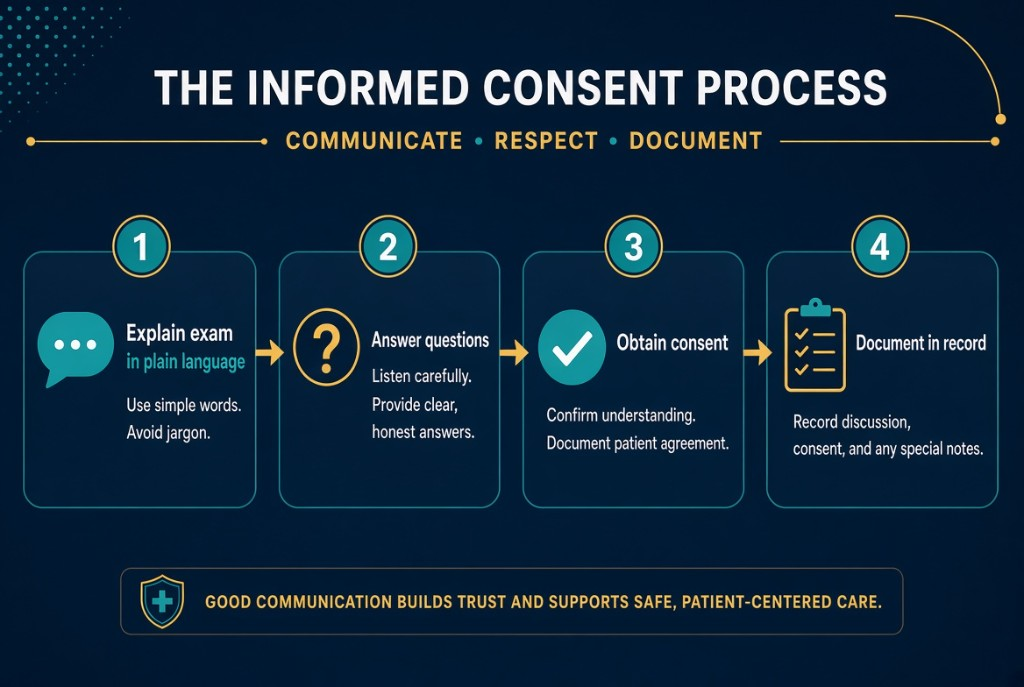
Informed consent is a patient's voluntary agreement to a procedure after learning what it involves. The patient must understand the nature of the procedure, its risks and benefits, the alternatives, and the right to refuse. Consent must be given freely, by a person who is able to decide, before the procedure begins. A patient can withdraw consent at any time, even partway through an exam.
The informed consent process
Two kinds
Simple consent covers routine exams. A patient who comes to the department, follows instructions, and positions for a chest x-ray is giving consent by those actions. Implied consent also applies in an emergency, when an unconscious patient needs care and would reasonably agree. Written informed consent is required for invasive or higher-risk procedures, such as arthrography, myelography, or angiography. Some facilities also require it for contrast injections, so follow your policy.
Who can consent
To give valid consent, the patient must be a competent adult. A sedated patient, or one under the influence of drugs or alcohol, cannot give valid consent, so consent is obtained before premedication. For minors, a parent or legal guardian consents, unless the minor is emancipated under state law. For adults who cannot decide for themselves, a legal guardian or health care power of attorney may consent. If the patient does not speak English well, use a qualified medical interpreter rather than a family member.
On the job
For invasive procedures, the physician performing the procedure is responsible for explaining it and obtaining informed consent. The radiographer may witness the signature, which confirms that the patient signed, not that the radiographer explained the risks. The radiographer still explains each step of the exam in plain language and checks understanding. Performing a procedure without consent can be considered battery. Document consent according to facility policy.
Clinical Example
A patient scheduled for an arthrogram says she is unsure what the needle is for. The radiographer does not answer the risk questions or let the exam start. She notifies the radiologist, who returns to explain the procedure before the patient signs.
Common Mistakes
- Having a patient sign consent after sedation has been given.
- Believing a witness signature means the radiographer explained the risks.
- Using a family member to interpret medical information.
- Continuing after the patient asks to stop.
Why It Matters
Consent protects patient autonomy and protects staff from legal claims. Registry questions focus on who can consent, which type applies, and the radiographer's role.
Key Relationships
- Routine exam → simple or implied consent by the patient's actions
- Invasive procedure → written informed consent from the physician
- Sedated or impaired patient → cannot give valid consent
- Consent can be withdrawn at any time