
Patient Care · Infection control2 min read5-question check
Infection Control and Standard Precautions
Treat every patient as potentially infectious, and add contact, droplet, or airborne precautions when needed.
The rule
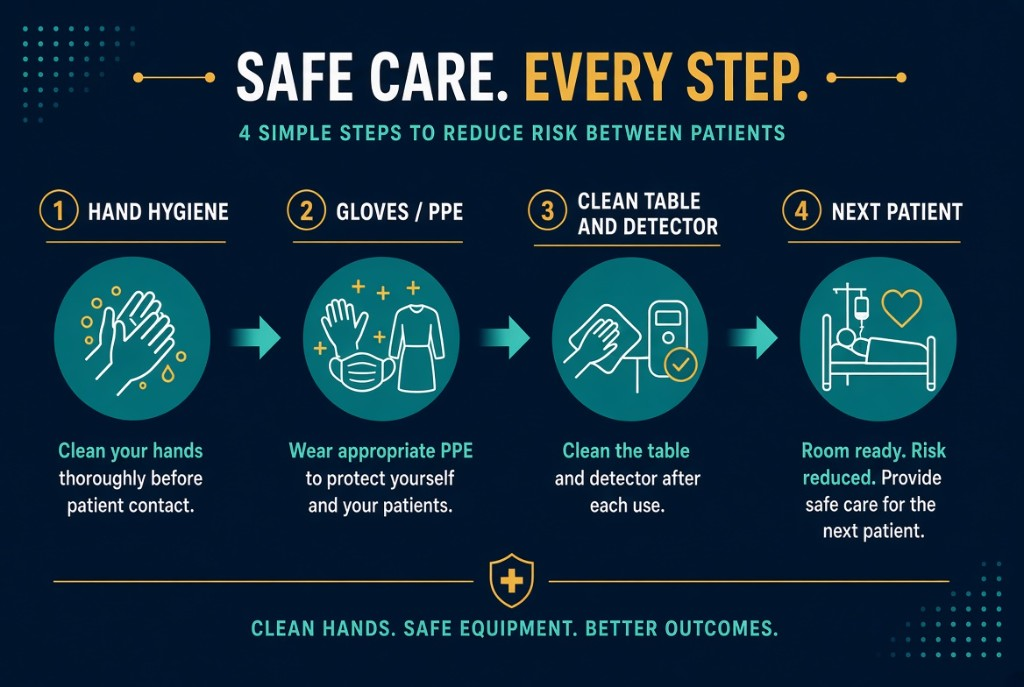
Standard precautions apply to every patient, whatever the diagnosis. Treat blood, all body fluids except sweat, nonintact skin, and mucous membranes as potentially infectious. The core actions are hand hygiene before and after patient contact, gloves when touching body fluids, more protective equipment when splashes are likely, safe handling of sharps, and cleaning equipment between patients. Never recap a used needle.
Safe care, every step
How it spreads
Infection spreads through a chain of six links: an infectious agent, a reservoir, a portal of exit, a mode of transmission, a portal of entry, and a susceptible host. Breaking any link stops the spread. Hand hygiene breaks the transmission link, which is why it is the single most important measure. Use an alcohol-based hand rub for most situations, but wash with soap and water when hands are visibly soiled or after caring for a patient with C. diff, because alcohol does not kill its spores.
Added precautions
Transmission-based precautions are added on top of standard precautions. Contact precautions, used for MRSA and C. diff, call for a gown and gloves. Droplet precautions, used for influenza and pertussis, call for a surgical mask when near the patient. Airborne precautions, used for tuberculosis, measles, and chickenpox, call for a fitted N95 respirator and a negative-pressure room. Protective, or reverse, isolation protects an immunocompromised patient from you.
On the job
Radiography equipment touches many patients, so clean the table, detector, and other surfaces after every patient with an approved disinfectant. For a mobile exam on an isolation patient, place the detector in a protective cover and use two radiographers when possible. One stays clean and runs the machine, and the other handles the patient. Put on protective equipment before entering, take gloves off first when leaving, and perform hand hygiene.
Clinical Example
A portable chest is ordered on a patient with C. diff. The radiographer gowns and gloves, bags the detector, and images with a partner who stays clean at the machine. Afterward she disinfects the detector and washes her hands with soap and water rather than using hand rub.
Common Mistakes
- Using alcohol hand rub after C. diff contact.
- Wearing a surgical mask instead of an N95 for tuberculosis.
- Cleaning the table only when it looks dirty.
- Touching the mobile unit with contaminated gloves.
Why It Matters
Shared equipment can carry infection from one patient to the next. The registry tests which precaution matches each disease and the proper protective equipment.
Key Relationships
- Hand hygiene → breaks the transmission link
- Contact → gown and gloves, such as MRSA or C. diff
- Droplet → surgical mask, such as influenza
- Airborne → N95 and negative-pressure room, such as TB