
Procedures · Extremities3 min read5-question check
Hand and wrist film check
Open joints and even shaft curves on the PA, metacarpal shafts apart on the oblique, bones stacked on the lateral, and no jewelry.
The PA hand
On a good PA hand, the fingers are straight and slightly spread, and the MCP and IP joints are open. The quickest rotation check is the shafts of the metacarpals and phalanges: the concave curve on each side of a shaft should look the same. If one side curves more than the other, the hand was turned. Keep the palm flat and the fingers flat on the IR. A finger that lifts off the IR shows closed IP joints and foreshortened phalanges.
The oblique hand
The PA oblique hand is turned 45 degrees laterally, thumb side up. Look at the midshafts of the 3rd, 4th and 5th metacarpals. They should not overlap. A little overlap of their heads near the knuckles is normal. Shafts that overlap mean the hand was turned too far; shafts spread wide apart with no overlap at the heads mean it was not turned enough. Support the fingers on a step sponge so they are parallel to the IR, or the IP joints close.
The lateral and the rings
The lateral hand is a true lateral with the fingers either extended and stacked, or fanned for the phalanges. The 2nd to 5th metacarpals superimpose and the distal radius and ulna superimpose. Before any hand or wrist exam, remove rings, watches and bracelets. A ring left on hides a fracture and the film is a repeat. If a ring will not come off over a swollen finger, tell the radiologist and the ordering provider rather than forcing it.
The wrist
On a PA wrist, arch the hand slightly so the wrist lies flat, and center on the midcarpal area. The distal radioulnar joint should be open and the carpals evenly spaced. On the lateral wrist, the elbow is flexed 90 degrees with the forearm and humerus on the same level, so the radius and ulna superimpose with the ulnar head over the radius. If the distal ulna shows clearly behind or in front of the radius, the wrist was rotated. For a suspected scaphoid fracture, add the ulnar deviation PA with the CR angled 10 to 15 degrees toward the elbow.
Read the films
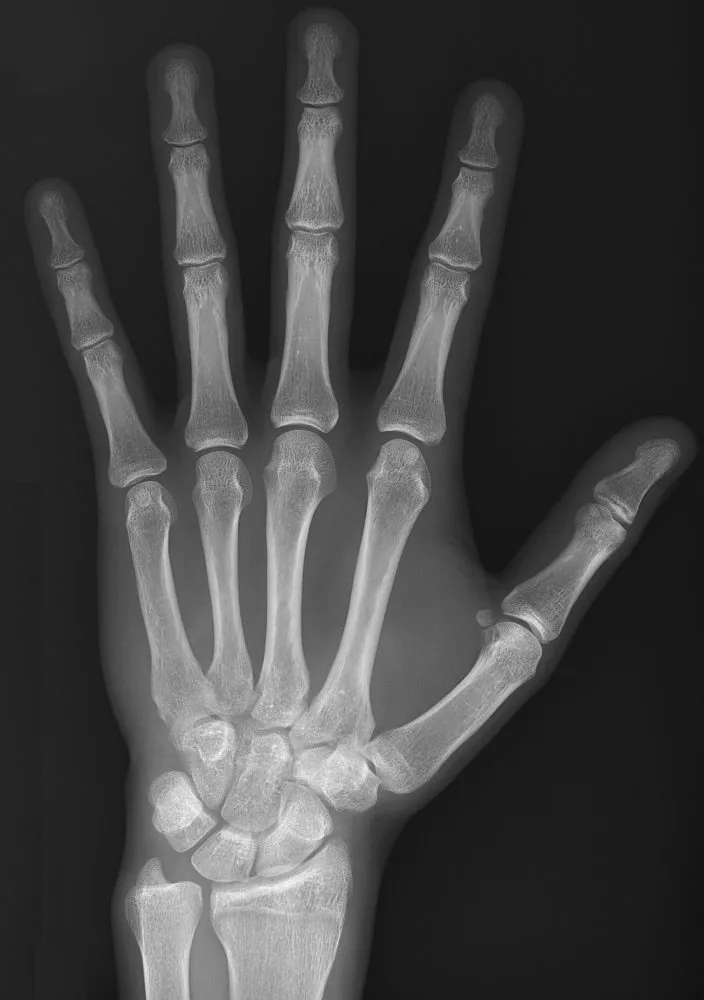
KeeperPA hand: a keeper
Look for: Fingers straight and slightly apart, MCP and IP joints open, and the shafts curve evenly on both sides. The thumb shows as an oblique, which is normal on a PA hand.
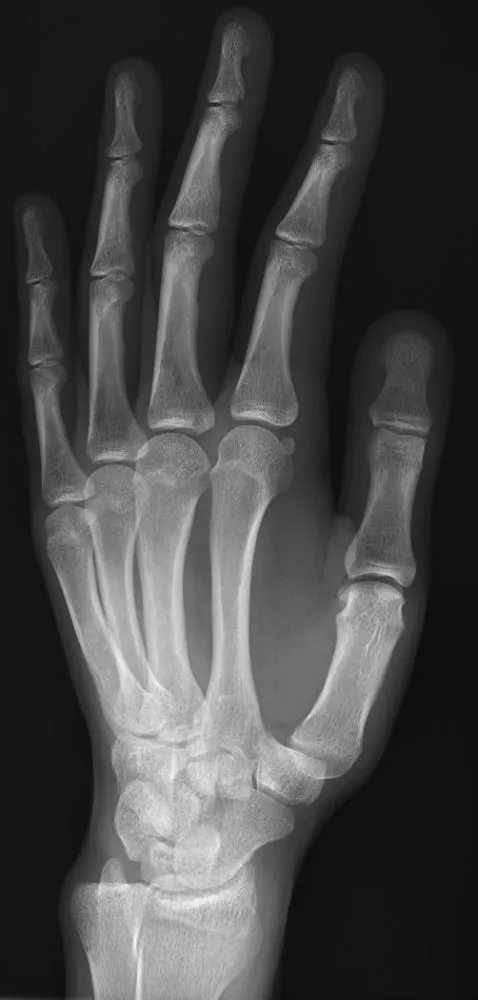
KeeperPA oblique hand: a keeper
Look for: The 3rd to 5th metacarpal shafts are separate, with only a little overlap at the heads. The fingers are flat enough that the IP joints are open.
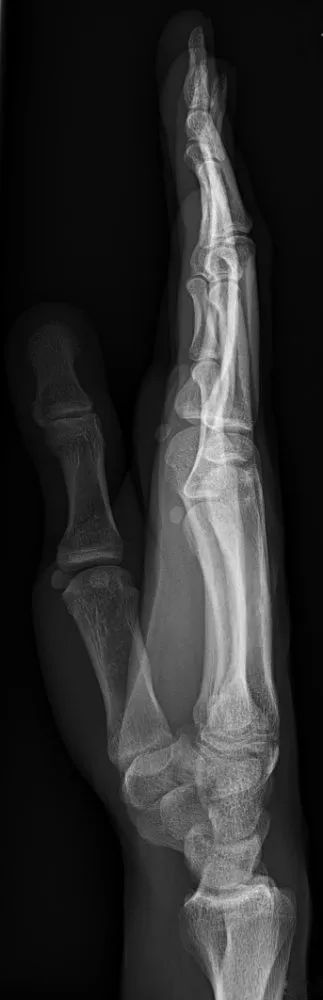
KeeperLateral hand in extension: a keeper
Look for: The fingers and the 2nd to 5th metacarpals are stacked, the thumb is free in front, and the distal radius and ulna superimpose.
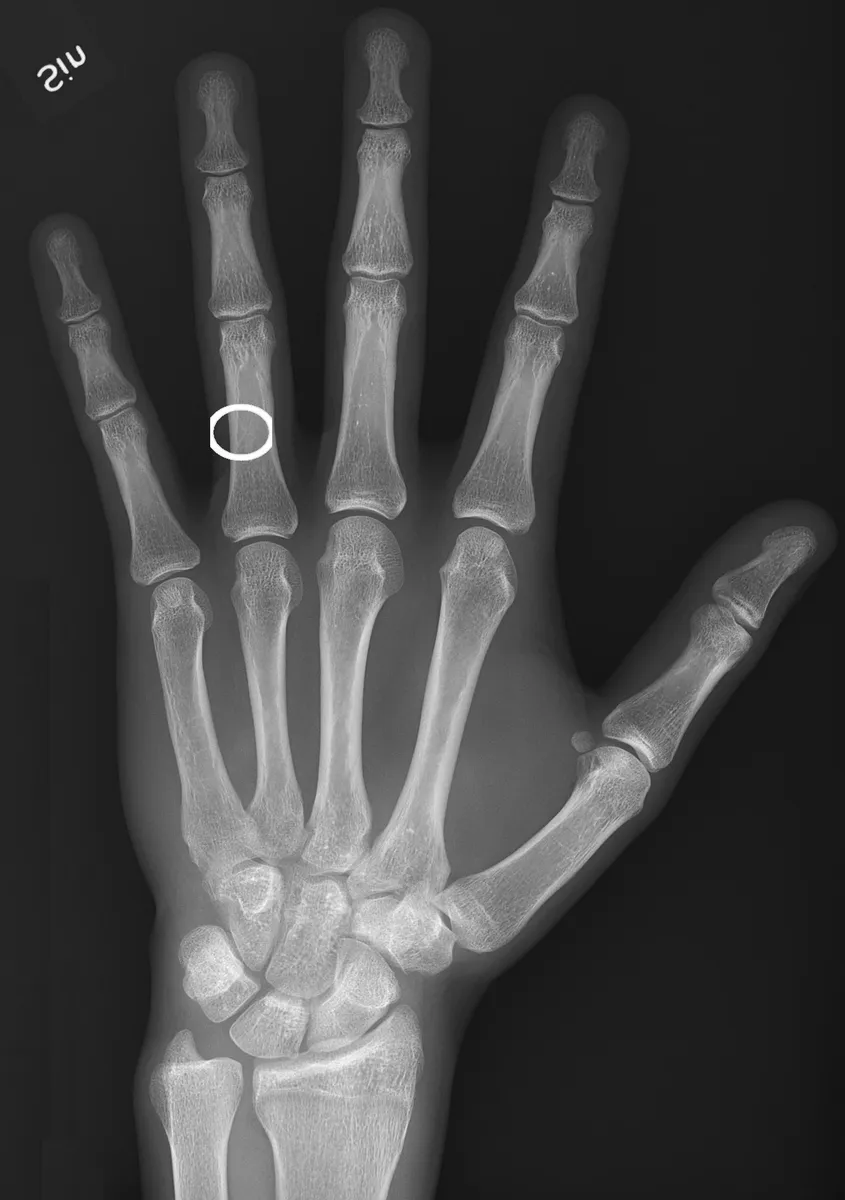
RepeatRing left on
Look for: A ring sits over the proximal phalanx. Anything under it, like a fracture line, is hidden.
Fix: Remove all jewelry before the first exposure. If a ring cannot come off, document it and tell the radiologist.
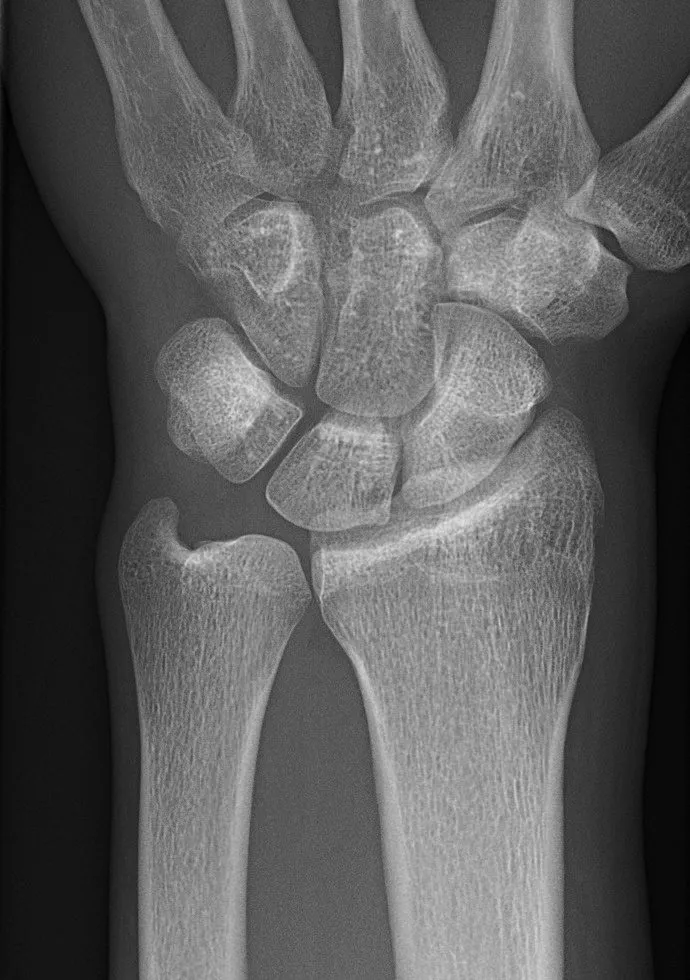
KeeperPA wrist: a keeper
Look for: The carpals are evenly spaced and the distal radioulnar joint is open. The wrist is flat, not rotated.
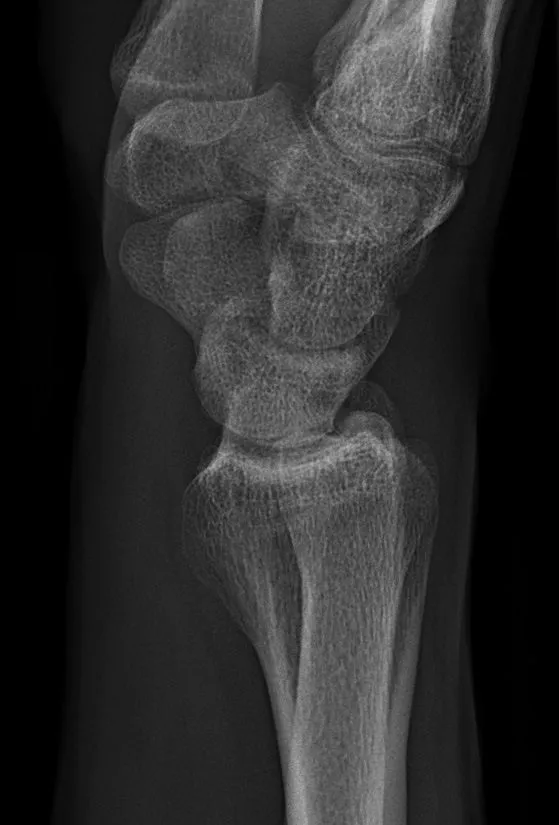
KeeperLateral wrist: a keeper
Look for: The distal radius and ulna superimpose, with the ulnar head over the radius. The carpals line up with the radius.
Clinical Example
Your PA oblique hand shows the 4th and 5th metacarpal shafts overlapping each other. You turn the hand back toward the IR until it is 45 degrees, rest the fingers on a step sponge, and repeat. The shafts now sit apart, with only the heads touching.
Common Mistakes
- Leaving a ring or watch on because the order says hand, not fingers.
- Letting the fingers droop on the oblique, which closes the IP joints.
- Over-rotating the oblique hand so the metacarpal shafts overlap.
- Taking the lateral wrist with the elbow straight, so the radius and ulna do not superimpose.
Why It Matters
Hand and wrist films are some of the most common orders in the ER and urgent care, and a boxer's fracture or a scaphoid fracture is easy to miss on a rotated or cluttered film.
Key Relationships
- Uneven shaft curves on the PA → rotation
- Oblique: 3rd to 5th metacarpal shafts overlap → turned too far
- Lateral wrist: elbow flexed 90°, radius and ulna superimposed
- Jewelry left on → repeat
- Scaphoid: ulnar deviation, CR 10 to 15° toward the elbow