
Procedures · Extremities2 min read5-question check
Hand and wrist
Hand to the 3rd MCP, wrist to midcarpal; for the scaphoid, ulnar deviate and angle toward the elbow.
Patient and part
Seat the patient at the end of the table, elbow flexed 90 degrees. For the PA hand, the palm lies flat on the IR with the fingers slightly spread. For the PA oblique, rotate the hand 45 degrees laterally with the fingers on a step sponge, parallel to the IR. For the lateral, put the ulnar side down. A fan lateral spreads the fingers to show each phalanx, and a lateral in extension shows metacarpals and foreign bodies. For the PA wrist, arch the hand slightly so the carpals touch the IR. The PA oblique wrist uses 45 degrees of lateral rotation, and the lateral wrist is ulnar side down.
PA wrist
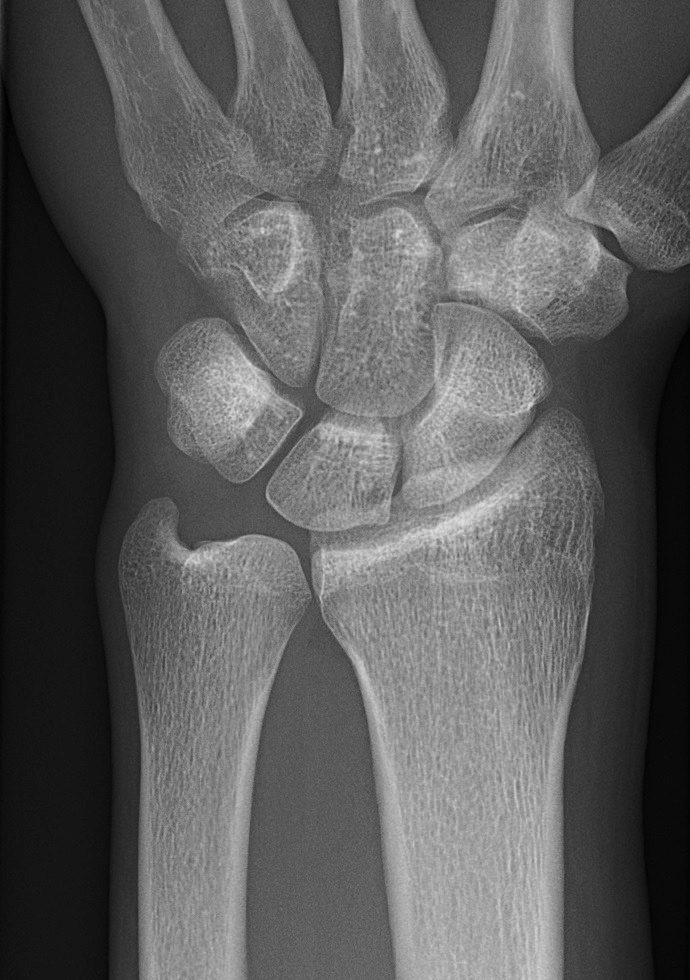
Central ray
Use 40 inches, about 100 cm. The PA and PA oblique hand are centered to the third MCP joint, and the lateral hand to the second MCP joint. Every routine wrist view is centered to the midcarpal area with a perpendicular CR. The scaphoid view is a PA axial wrist: ulnar deviate the hand and angle the CR 10 to 15 degrees proximally, toward the elbow, along the long axis of the forearm. Variants include the modified Stecher, with the hand on a 20 degree sponge and a perpendicular CR, and the Rafert-Long series at several increasing CR angles.
What a good image shows
On a PA hand, the shafts of the metacarpals and phalanges show equal concavity on both sides, and the MCP and IP joints are open. On a PA oblique hand, the midshafts of the third through fifth metacarpals overlap only slightly. On the lateral wrist, the distal radius and ulna are superimposed. On the scaphoid view, the scaphoid is elongated with open joint spaces around it.
Fixing it
On a PA oblique hand, too much overlap of the third through fifth metacarpals means over-rotation, and too much separation means under-rotation. On the oblique, closed IP joints mean the fingers were not parallel to the IR. If the radius and ulna are not superimposed on a lateral wrist, the forearm was rotated.
Clinical Example
A skateboarder fell on an outstretched hand and is tender in the anatomic snuffbox. The routine wrist views look normal, so you add an ulnar deviation scaphoid view angled 15 degrees toward the elbow. It shows a fracture line through the scaphoid waist.
Common Mistakes
- Centering the PA hand to the wrist or the fingers instead of the third MCP joint.
- Letting the fingers droop on the oblique, which closes the IP joints.
- Angling the scaphoid CR toward the fingers instead of toward the elbow.
- Using radial deviation for the scaphoid, which foreshortens it.
Why It Matters
Scaphoid fractures are easy to miss and can lead to avascular necrosis, so the extra view protects the patient. The registry tests centering points, rotation errors on the oblique and the scaphoid CR direction.
Key Relationships
- PA and PA oblique hand: CR to third MCP joint
- Wrist views: CR to midcarpal area
- Scaphoid: ulnar deviation, CR 10 to 15 degrees toward the elbow
- Excess metacarpal overlap on oblique: over-rotated