
Image Production · Scatter, grids and filtration2 min read5-question check
Grid ratio and cleanup
Higher grid ratio cleans up more scatter but costs dose and tolerates less misalignment.
The rule
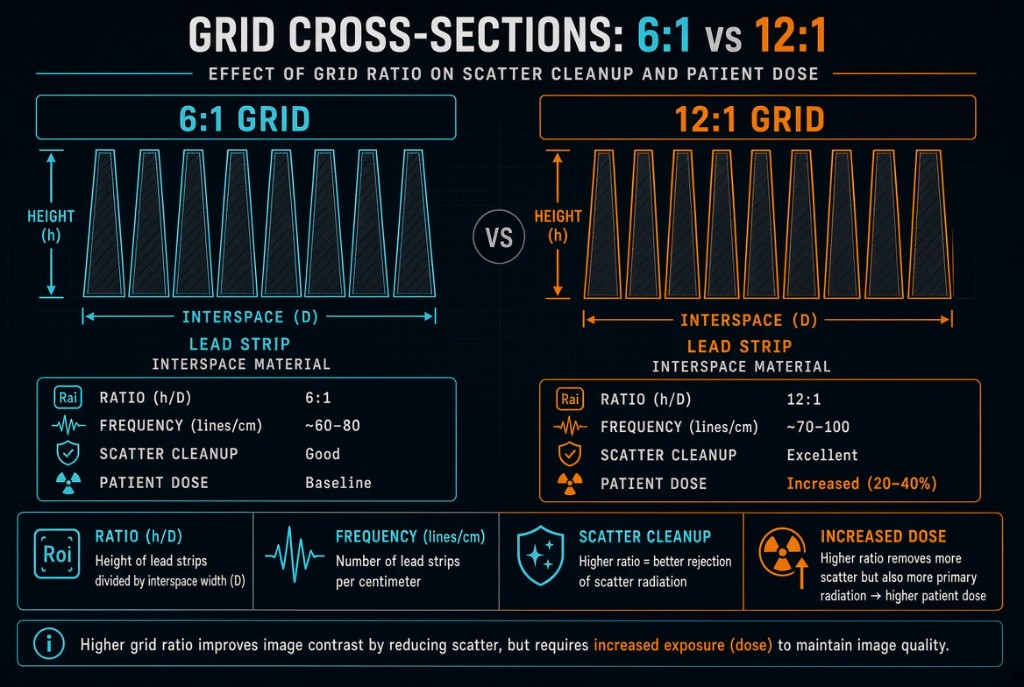
A grid is a series of thin lead strips separated by radiolucent interspace material, placed between the patient and the receptor. It absorbs scatter before it reaches the receptor, which improves contrast. Grid ratio is the height of the lead strips divided by the distance between them, so taller strips or narrower gaps mean a higher ratio. Common ratios run from 5:1 to 16:1. A grid is generally used when the part is thicker than 10 cm and the technique is above 60 kVp.
Grid Ratio Comparison
How it works
Primary photons travel nearly straight through the interspaces. Scatter leaves the patient at angles, strikes the lead, and is absorbed. A higher ratio narrows the angle at which a photon can still get through, so it absorbs more scatter. Cleanup improves and contrast rises. The cost is that the grid also absorbs some primary photons, so mAs must increase to keep receptor exposure the same, and patient dose rises with it.
Positioning latitude
Positioning latitude is how much misalignment a grid tolerates before grid cutoff, the unwanted absorption of primary photons. The higher the ratio, the smaller the latitude. An off-level grid, or a tube angled across the strips, causes cutoff across the whole image. Lateral decentering does the same. A focused grid used outside its focal range causes cutoff at the edges, and a focused grid placed upside down causes severe cutoff on both sides with only the center exposed. Angling along the length of the strips does not cause cutoff. This is why mobile work often uses lower ratios such as 6:1 or 8:1.
Grid frequency
Grid frequency is the number of lead strips per inch or centimeter. Higher frequency means thinner strips, so grid lines are less visible. Frequency mainly affects line visibility; ratio has the larger effect on cleanup. A moving grid in the bucky blurs its lines during exposure, while stationary grids rely on high frequency.
Clinical Example
A portable AP abdomen comes back noisy across the whole image, with a low deviation index. The patient's weight tilted the grid on the soft mattress, so the grid was off level and the beam crossed the strips at an angle. Leveling the grid and centering carefully fixes the repeat.
Common Mistakes
- Defining grid ratio as strip width or as lines per inch.
- Thinking a higher ratio lets you lower mAs.
- Using a high-ratio grid for mobile work, where alignment is hardest.
- Placing a focused grid upside down.
Why It Matters
The right grid improves contrast without wasted dose or cutoff. The registry tests the ratio formula, the cleanup and dose trade-off, and the pattern each type of cutoff produces.
Key Relationships
- Grid ratio = strip height ÷ interspace width
- Higher ratio → more cleanup, more dose
- Higher ratio → less positioning latitude
- Higher frequency → less visible grid lines