
Image Production · Scatter, grids and filtration2 min read5-question check
Grid cutoff
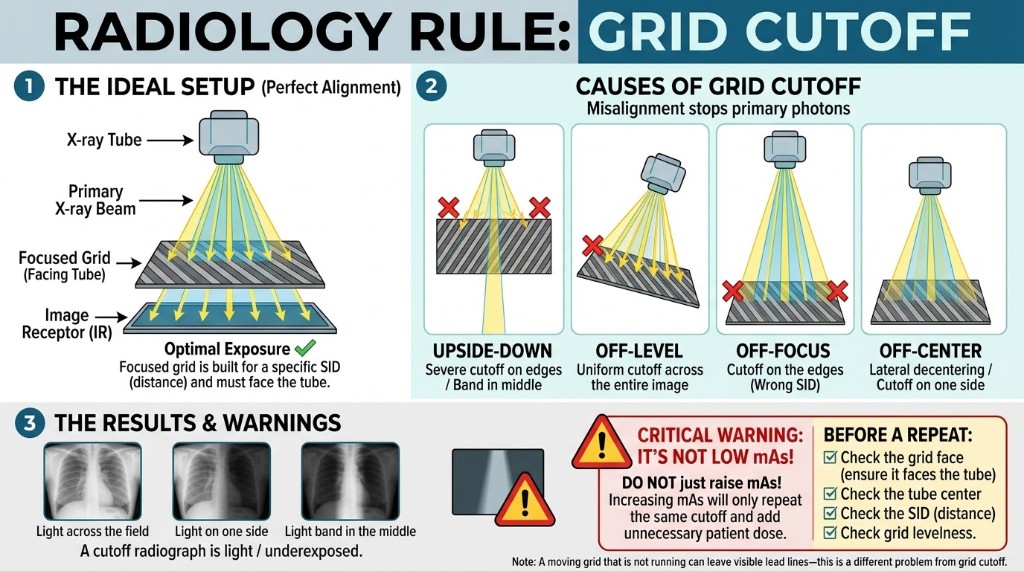
Grid cutoff is the grid absorbing primary photons because of misalignment; more mAs never fixes it.
The rule
Grid cutoff is the loss of primary photons absorbed by the grid because the beam and the grid are misaligned. The result is lower receptor exposure across all or part of the image. In digital radiography the image may not simply look light, because processing adjusts brightness, but the exposure indicator falls, noise rises, and part of the field may look uneven. The fix is alignment, not technique.
Why it happens
In a focused grid, the lead strips are tilted so each one points toward a line in space above the grid, set by its focal distance. Primary photons from a correctly placed tube travel parallel to the strips and pass through the interspaces. When the tube is off center, the grid is tilted, the SID is outside the grid's focal range, or the grid faces the wrong way, photons strike the strips at an angle and are absorbed.
Four errors
Each error leaves a signature. An upside-down focused grid causes severe cutoff at both edges, with exposure only down the center. Off-focus, meaning an SID outside the focal range, causes loss toward both edges. Off-level, where the grid is tilted across its strips, causes loss across the entire image. Off-center, where the central ray is shifted across the strips, also causes an even loss across the whole field. Angling the tube along the length of the strips does not cause cutoff. Angling across them does.
On the job
Mobile exams are the classic setup. A grid slid under a patient in a sagging bed or a tilted chair is easily off level, and the tube is often not centered to it. Before a repeat, check that the tube side of the grid faces the tube, the grid is level, the central ray is centered, and the SID matches the grid label. Raising mAs only repeats the cutoff at a higher dose.
Clinical Example
A portable AP abdomen comes back with a low exposure indicator and a noisy image. The mattress dipped under one side, so the grid was tilted across its strips. You level the grid with a sponge, recenter the tube, and repeat with the same technique.
Common Mistakes
- Repeating a cutoff image with more mAs, which adds dose and leaves the cause in place.
- Angling the tube across the strips of a linear grid instead of along them.
- Using a focused grid at a distance outside its labeled focal range.
- Confusing cutoff with grid lines, which are images of the strips themselves, not a loss of exposure.
Why It Matters
Cutoff is a common cause of mobile repeats and wasted patient dose. The registry describes an image pattern and asks you to name the alignment error behind it.
Key Relationships
- Upside-down focused grid → severe cutoff at both edges, center exposed
- Off-focus → loss toward both edges
- Off-level or off-center → loss across the whole image
- Angle along the strips → no cutoff; across the strips → cutoff