
Safety · Radiation protection and dose2 min read5-question check
Protecting Yourself in Fluoroscopy and Mobile Work
The patient is your radiation source. Minimize time, maximize distance, use lead, and stand on the image receptor side.
The rule
Time, distance and shielding are the cardinal principles of radiation protection. In fluoroscopy and mobile work, the main source of your dose is the patient, who scatters the beam in all directions. Keep beam-on time short, stand as far from the patient as the task allows, and keep lead between you and the patient. Of the three, distance is usually the most effective.
Where scatter is strongest, and where to stand
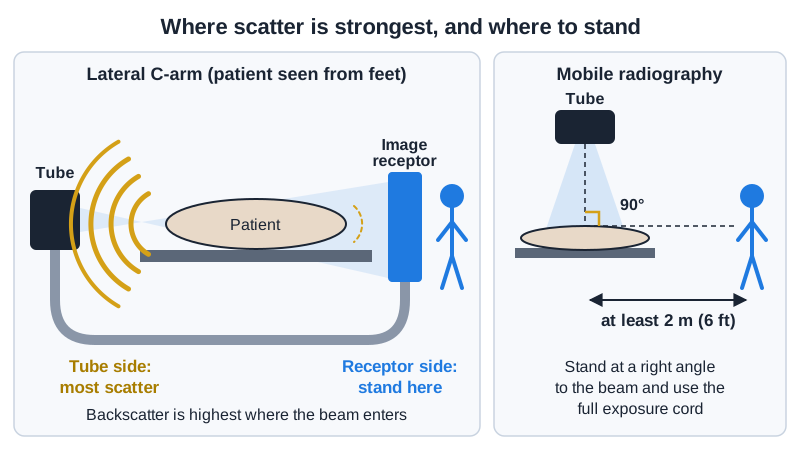
Where scatter goes
Scatter is strongest where the beam enters the patient, because most interactions happen near the entrance surface and some photons bounce back toward the tube. With the tube under the table, that heavy scatter is directed down and away from the operator's head and neck. For a lateral C-arm projection, the tube side has the most scatter, so stand on the image receptor side. In a fluoroscopy room, the Bucky slot cover closes the gap at gonad level when the Bucky tray is moved to the foot of the table. The protective curtain hangs from the tower between the operator and the patient.
The numbers
At 1 m from the patient, at 90 degrees to the beam, scatter is about 0.1 percent of the primary beam intensity. Distance follows the inverse square law. Worked example: if the scatter rate is 2 mGy per hour at 1 m, stepping back to 2 m cuts it to 0.5 mGy per hour. Protective aprons for fluoroscopy are 0.5 mm Pb equivalent, with 0.25 mm as the minimum. Thyroid shields are 0.5 mm Pb, and protective gloves are 0.25 mm Pb. The Bucky slot cover and protective curtain are each at least 0.25 mm Pb. The fluoroscopy timer sounds at 5 minutes of beam-on time.
On the job
For mobile radiography, stand at least 2 m (6 ft) from the patient and the tube, at a right angle to the beam. The exposure cord must be long enough to allow this. Wear an apron for every mobile exposure. Lead aprons do not stop the primary beam, so never stand in it.
Clinical Example
During a hip pinning, the surgeon asks for a cross-table lateral with the C-arm. The radiographer moves to the image intensifier side of the table, away from the tube, and steps back before the surgeon presses the pedal. Her collar badge readings stay low for the month.
Common Mistakes
- Standing on the tube side during a lateral C-arm projection.
- Placing the C-arm tube above the patient for routine AP views, which sends heavy scatter toward the operator's head and neck.
- Standing close to the patient during a mobile exam because the cord is coiled up.
- Thinking an apron makes it safe to stand in the primary beam.
Why It Matters
Most of a radiographer's occupational dose comes from fluoroscopy and mobile work. The registry tests where to stand, required lead equivalents and the 2 m rule.
Key Relationships
- Beam entrance side → most scatter
- Double the distance → one fourth the dose
- Lateral C-arm → stand on the image receptor side
- Mobile exam → 2 m away at 90 degrees