
Image production2 min read5-question check
15% kVp rule
Raise kVp 15% and receptor exposure about doubles; lower it 15% and exposure about halves.
The rule
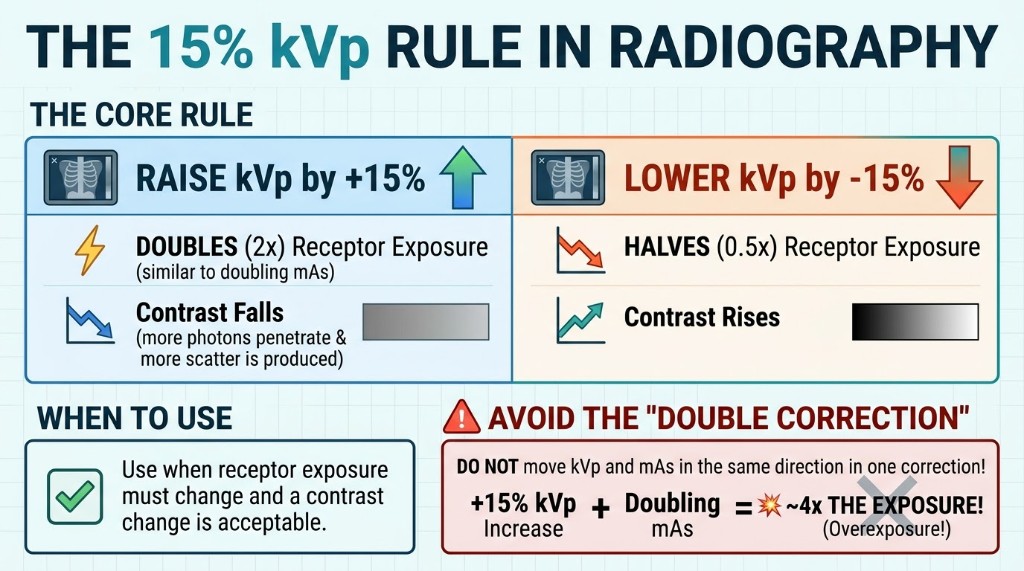
Increasing kVp by 15% roughly doubles receptor exposure, the same effect as doubling mAs. Decreasing kVp by 15% roughly halves it. The rule lets you trade kVp against mAs while keeping exposure steady: raise kVp 15% and cut mAs in half, or lower kVp 15% and double mAs. It is an approximation that works best in the middle of the diagnostic range.
Why it happens
kVp controls photon energy. Higher energy photons penetrate the patient more easily, so more of them reach the receptor, and the tube also produces more photons at higher kVp. Together these explain why a modest kVp change has such a large effect. The trade-off is contrast. At higher kVp, tissues absorb more alike and more Compton scatter is produced, so subject contrast falls. Lower kVp raises subject contrast, but only if the beam still penetrates the part. No amount of mAs can make up for a beam that does not get through.
The numbers
To find 15%, multiply kVp by 0.15. At 80 kVp, 15% is 12, so a 15% increase is 92 kVp and a 15% decrease is 68 kVp. Worked example: a lateral lumbar spine is set at 85 kVp and 40 mAs. To lower patient dose while keeping receptor exposure, raise kVp by about 13 to 98 kVp and halve mAs to 20. Going the other way, 70 kVp at 10 mAs becomes about 60 kVp at 20 mAs.
In practice
In digital radiography the displayed contrast is largely set by processing, so a higher kVp costs less visible contrast than it did with film. That is why many departments favor higher kVp with lower mAs: the patient receives less entrance dose for the same exposure indicator. Scatter still increases, though, so collimation and grids still matter.
Clinical Example
An adequately penetrated AP shoulder taken at 70 kVp and 10 mAs shows an exposure indicator at about half the target. You can double mAs to 20, or raise kVp 15% to about 80 and keep 10 mAs. Both roughly double receptor exposure, but the kVp change gives the patient less dose.
Common Mistakes
- Adding 15 kVp instead of 15 percent, which overshoots at lower kVp settings.
- Raising kVp 15% and also doubling mAs, which gives about four times the exposure.
- Adding mAs to an underpenetrated image when the beam needs more kVp.
- Treating the rule as exact at every kVp; it is a working approximation.
Why It Matters
The rule is your main tool for lowering dose without losing receptor exposure and for correcting exposure in one step. The registry asks you to compute the new kVp and to predict the effect on exposure, contrast, and dose.
Key Relationships
- kVp up 15% → receptor exposure about doubles
- kVp down 15% → receptor exposure about halves
- kVp up 15% with mAs halved → same exposure, less dose, lower contrast
- Higher kVp → more scatter, lower subject contrast