
Safety · Radiobiology2 min read5-question check
Early vs Late Somatic Effects
Sort effects by timing: early effects follow high doses within days to weeks; late effects appear years later.
The rule
Somatic effects appear in the person who was exposed. Genetic, or hereditary, effects appear in that person's future children. Somatic effects are sorted by when they appear. Timing is a separate question from the dose-response model, so classify every effect two ways: early or late, and deterministic or stochastic.
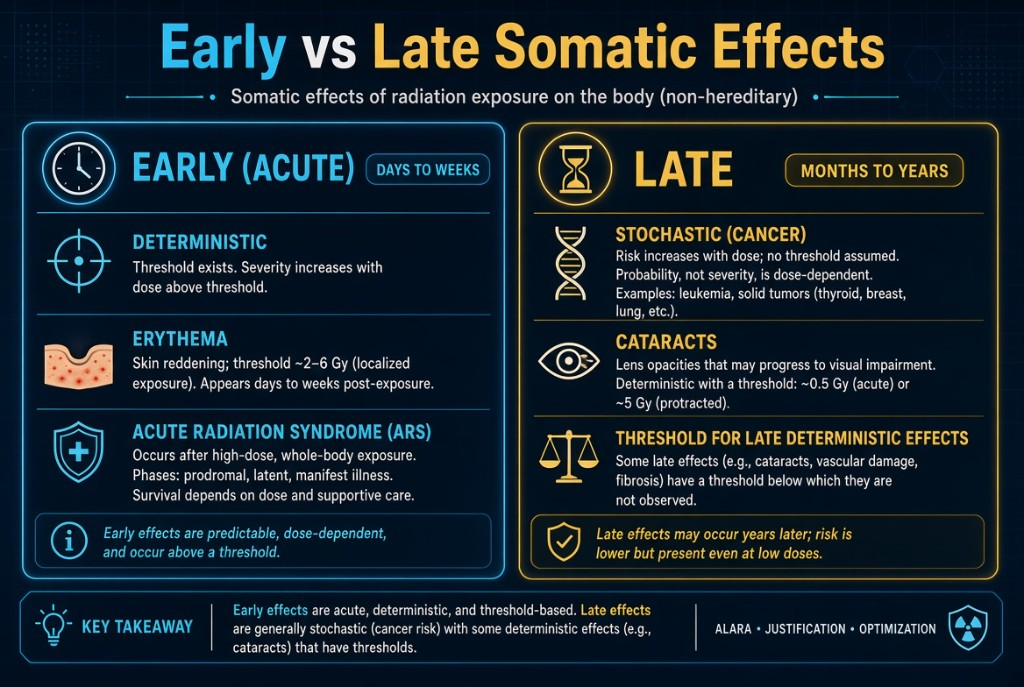
Early vs late somatic effects
Early effects
Early somatic effects appear within hours to weeks and only after high doses. They come from widespread cell killing, so they are deterministic, with thresholds. They include the acute radiation syndromes, local tissue damage such as skin erythema, desquamation, and epilation, a drop in blood cell counts, and chromosome damage seen in blood cells.
Late effects
Late somatic effects appear months to years after exposure, and they can follow either a single high dose or many small doses over time. The most important is cancer. Leukemia can appear within a few years, while solid cancers such as breast, thyroid, and lung often take a decade or more. Cancer is stochastic. Cataracts are also late, but they are deterministic, with a threshold. Life-span shortening was seen in animal studies and heavily exposed early radiologists but is not expected at today's dose levels.
On the job
Diagnostic radiography does not produce early effects because its doses are far too low. The real concern for patients and radiographers is late stochastic effects, mainly cancer. That is why technique optimization, collimation, and personnel monitoring all aim to keep lifetime dose low.
Clinical Example
A patient asks whether her lumbar spine series will make her hair fall out. You explain that hair loss is an early effect that needs a dose far higher than any radiograph delivers. The small risk that remains is a late stochastic effect, which is why you collimate tightly and aim to get every image right the first time.
Common Mistakes
- Assuming every late effect is stochastic, when cataracts are late but deterministic.
- Confusing somatic effects in the exposed person with genetic effects in offspring.
- Expecting early effects from diagnostic doses.
- Thinking late effects require a high dose, when they can follow small doses accumulated over years.
Why It Matters
Late effects, especially cancer, drive every dose limit and ALARA practice in radiography. The registry often asks you to classify an effect by timing and by threshold at the same time.
Key Relationships
- Somatic = exposed person; genetic = offspring
- Early = hours to weeks, high dose, deterministic
- Late = months to years; cancer is the main one
- Cancer = late + stochastic; cataract = late + deterministic
- Skin erythema and epilation = early + deterministic