
Safety · Radiation protection and dose2 min read5-question check
Dose Area Product
DAP = air kerma × field area. Tighter collimation cuts it; distance from the tube does not.
The rule
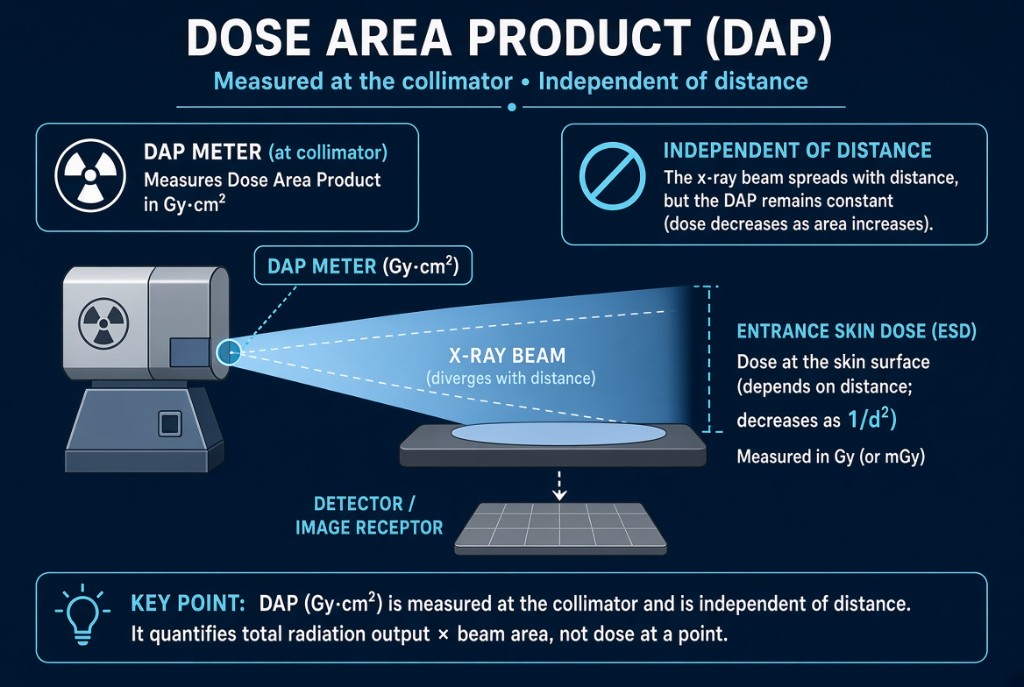
Dose area product, or DAP, is the air kerma in the x-ray beam multiplied by the area of the beam. It is reported in units such as Gy·cm² or mGy·cm². It is usually measured by a flat transmission ionization chamber mounted at the collimator exit, so the reading includes all the radiation leaving the tube housing toward the patient; some systems calculate it from technique and collimator settings instead. You may also see it called kerma area product, or KAP.
Dose Area Product
How it works
DAP stays the same at any distance from the source along the primary beam. As the beam travels farther, air kerma drops by the inverse square law, but the field area grows by the square of the distance. The two changes cancel. That is why one chamber at the collimator can describe the beam that reaches the patient.
The numbers
Suppose the air kerma is 2 mGy and the field measures 20 cm by 20 cm. The area is 400 cm², so DAP is 2 × 400 = 800 mGy·cm². Collimate to 10 cm by 20 cm and the area becomes 200 cm². With the same technique, DAP falls to 400 mGy·cm², half the value. Doubling mAs with the same field doubles air kerma, so it doubles DAP too.
On the job
DAP reflects the total radiation directed at the patient, so it correlates reasonably well with stochastic risk and effective dose. It is a poor guide to peak skin dose, because a small, intense field and a large, weak field can produce the same DAP. For skin injury risk in long fluoroscopy cases, watch cumulative air kerma at the reference point. DAP is also used to set and compare diagnostic reference levels.
Clinical Example
During a long fluoroscopic swallow study, the radiologist asks you to document dose. You record fluoroscopy time, cumulative air kerma, and cumulative DAP from the console. Because you collimated tightly to the esophagus from the start, the DAP is well below that of a similar case done with an open field.
Common Mistakes
- Thinking DAP gets smaller farther from the tube; it stays constant along the primary beam.
- Treating DAP as entrance skin dose, even though it combines intensity and area and cannot locate a skin hot spot.
- Forgetting that collimation lowers DAP even when kVp and mAs do not change.
- Mixing up units: DAP is in Gy·cm², while air kerma alone is in Gy.
Why It Matters
DAP is a useful single number for the total radiation a patient received from an exam, and it is recorded for dose tracking and quality review. The registry tests what it measures, its units, and how collimation and distance affect it.
Key Relationships
- DAP = air kerma × field area
- Halve the field area → DAP halves
- Double the mAs → DAP doubles
- Double the distance → air kerma 1/4, area ×4, DAP unchanged
- DAP tracks stochastic risk; cumulative air kerma tracks skin injury risk