
Image Production · Digital imaging and processing2 min read5-question check
Detector Fill Factor and DQE
Fill factor is how much of each pixel senses x-rays; DQE is how efficiently dose becomes image quality.
The rule
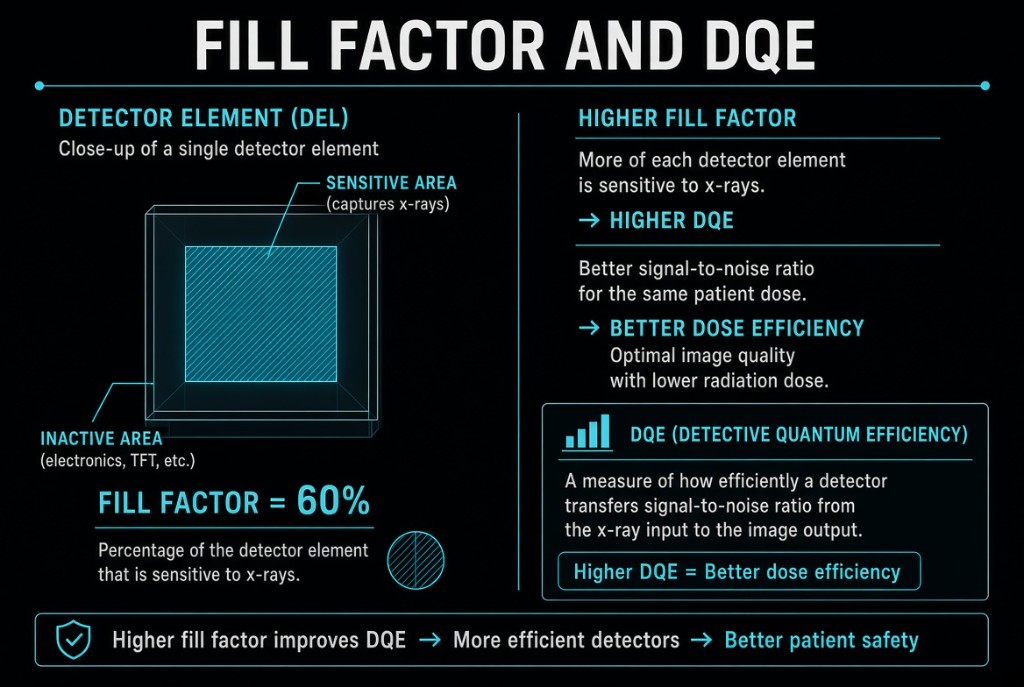
A flat-panel detector is a grid of detector elements, or DELs. Each DEL contains a sensing area plus electronics, mainly a thin-film transistor that acts as a switch to read out the signal. Fill factor is the percentage of the DEL's area that is actually sensitive to radiation. Detective quantum efficiency, or DQE, is how efficiently the whole detector turns incoming x-rays into a useful, low-noise image.
Fill Factor and DQE
The numbers
Suppose a DEL measures 100 by 100 micrometers, an area of 10,000 square micrometers. If the transistor and wiring take up 2,000 square micrometers, the sensitive area is 8,000. The fill factor is 8,000 ÷ 10,000, or 80 percent. DQE is a fraction from 0 to 1. A perfect detector would have a DQE of 1, keeping all the information carried by the incoming photons.
The trade-off
The electronics in each DEL take up about the same space no matter how small the DEL is. Making DELs smaller improves spatial resolution, but the electronics then occupy a bigger share of each one, so fill factor falls. Less signal is captured, noise rises, and more exposure may be needed. Detector design balances fine resolution against efficient signal capture.
On the job
DQE depends on how many x-rays the detector absorbs and how much noise it adds. A thicker or higher atomic number absorber raises absorption and DQE. In indirect detectors, cesium iodide grown in needle-like columns channels light toward the photodiode, so it can be thick enough to absorb well without spreading light as much. A higher DQE means a diagnostic image at lower patient dose.
Clinical Example
Your department replaces an older detector with a cesium iodide panel that has a higher DQE. The physicist and lead technologist lower the protocol techniques. Images remain diagnostic, exposure indicators stay in range, and patient doses drop.
Common Mistakes
- Thinking smaller DELs always improve the image; they improve resolution but lower fill factor.
- Confusing fill factor, a fraction of each DEL's area, with DQE, which describes the whole detector.
- Believing a higher DQE requires more dose, when it allows less dose for the same quality.
- Assuming DQE can be greater than 1.
Why It Matters
Fill factor and DQE explain why some detectors produce diagnostic images at lower dose. The registry tests the definitions, the DEL size trade-off, and the link between high DQE and lower patient dose.
Key Relationships
- Fill factor = sensitive area ÷ total DEL area
- Smaller DEL → better spatial resolution, lower fill factor
- Higher fill factor → more signal captured, less noise
- Higher DQE → same image quality at lower dose