
Safety · Radiation protection and dose2 min read5-question check
ALARA in Practice
Time, distance, shielding, tight collimation, and no needless repeats: the daily habits that keep dose low.
The rule
ALARA stands for as low as reasonably achievable. It means every exposure should give a diagnostic image with no more radiation than needed, for the patient, for you, and for anyone nearby. It is not a single dose number. It is a set of habits you use on every exam.
ALARA Principles
Time and distance
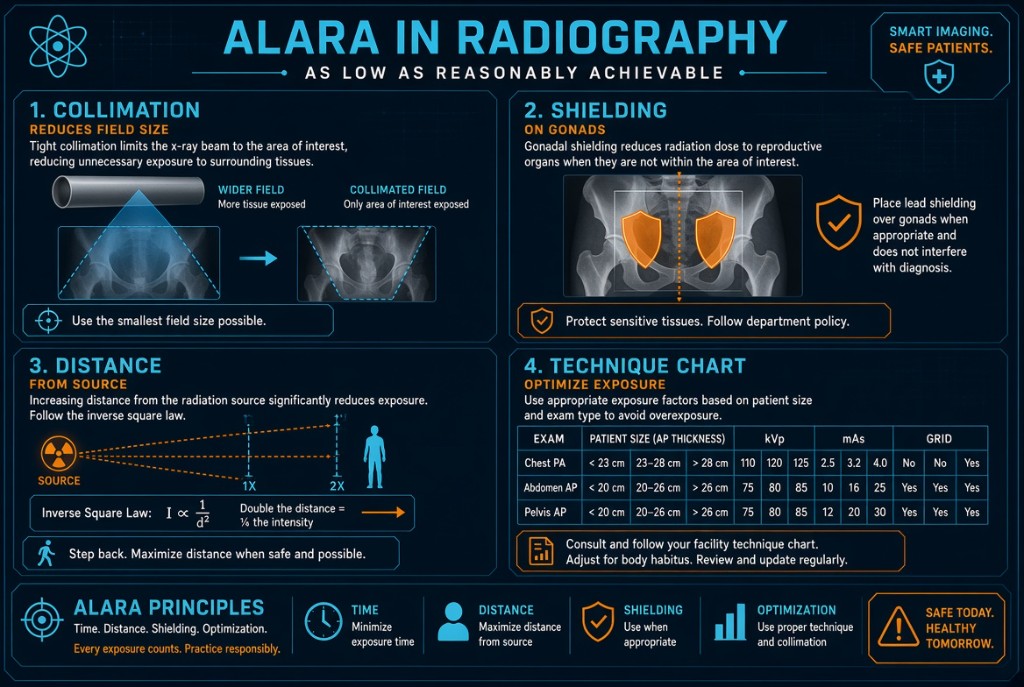
The three cardinal principles are time, distance, and shielding. Less time near the source means less exposure, which matters most in fluoroscopy. Distance is the strongest tool you have, because of the inverse square law. Worked example: if you stand 3 feet from the patient during a mobile exposure and step back to 6 feet, your exposure drops to one-fourth. Mobile units have an exposure cord at least 6 feet long so you can do exactly that.
Shielding
For staff, shielding means lead aprons, thyroid shields, and standing behind the control booth barrier. For patients, current AAPM and NCRP guidance no longer recommends routine gonadal and fetal shielding. The dose it saves is very small, and a shield can hide anatomy or confuse automatic exposure control and cause a repeat. Some state rules and department policies still differ, so follow your department policy on when shielding is used. Collimation is the patient shield that always works: a smaller field means less tissue irradiated and less scatter.
On the job
Repeats double the dose for that projection, so prevention matters. Clear instructions, good immobilization, careful positioning, and correct technique prevent most of them. Screen patients of childbearing age for possible pregnancy before abdominal and pelvic exams. Never hold a patient yourself; use immobilization devices or a non-pregnant family member wearing lead. Image Gently guides child-sized dose, and Image Wisely does the same for adults.
Clinical Example
During a portable chest in the ICU, a nurse is at the bedside. The technologist asks the nurse to step out, collimates to the lungs, explains the breath hold, and moves the full length of the exposure cord away before exposing. The image is good on the first attempt.
Common Mistakes
- Placing a gonadal shield by habit when it may cover anatomy or trigger a repeat.
- Opening the collimator wide to save positioning time.
- Holding a patient during exposure instead of using an immobilizer.
- Skipping pregnancy screening on a busy shift.
Why It Matters
Small daily choices add up to most of the dose patients and staff receive. The registry tests the cardinal principles, the inverse square law, and correct holding and pregnancy procedures.
Key Relationships
- Double your distance → exposure falls to 1/4
- Less beam-on time → less exposure
- Smaller field size → less tissue irradiated and less scatter
- One repeat → twice the dose for that projection