
Image Production · Equipment, AEC and QC2 min read5-question check
AEC versus manual technique
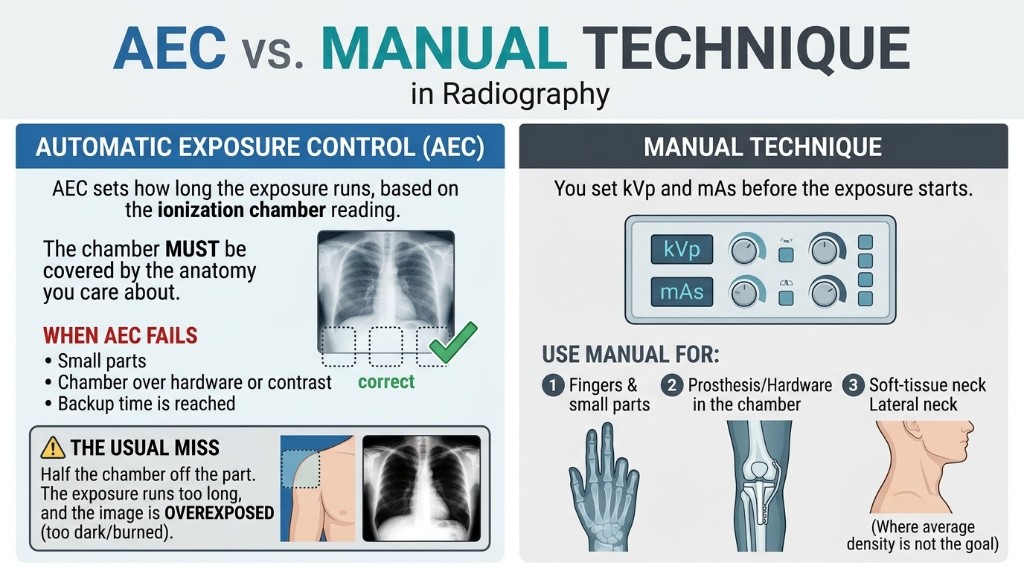
AEC stops the exposure once its chambers get enough radiation, so what covers the chamber decides the result.
The rule
With manual technique, you set kVp and mAs from a technique chart, and the machine delivers exactly that. With automatic exposure control, you still choose kVp, mA, the active chambers, and a backup time. The AEC then ends the exposure when the radiation reaching its ionization chambers equals a preset level. AEC controls exposure time, and therefore mAs. It never chooses kVp for you.
How it works
The chambers sit between the patient and the image receptor and read only what passes through the anatomy directly over them. Center the anatomy of interest over the selected chamber. For a PA chest, select the two outer chambers under the lungs. For a lateral lumbar spine, select the center chamber under the vertebral bodies. If raw radiation reaches an active chamber, the exposure ends almost at once and the image is underexposed. If metal or positive contrast sits over the chamber, the exposure runs long and the patient is overexposed. Collimating too wide adds scatter that can end the exposure early.
The numbers
Set the backup timer at about 150 percent of the expected exposure time. Worked example: if you expect a 100 ms exposure, set the backup near 150 ms. It is a safety stop for a runaway exposure, not a technique setting. The plus and minus exposure adjustment controls are for patient size or pathology, not for fixing poor centering. Also remember minimum response time: on a very thin part, the shortest exposure the AEC can make may still be more than the part needs.
In practice
Choose manual technique when the part cannot fully cover a chamber, such as fingers, toes, or a small child; when hardware or contrast will lie over the chamber; for tabletop work off the bucky; and for most mobile exams. Under AEC, raising kVp shortens the exposure time and lowers mAs and dose.
Clinical Example
You image a lateral hip on a patient with a total hip replacement using the center chamber. The metal stem lies over the chamber, the exposure runs to the backup time, and the deviation index is far above target. For the next patient with hardware, you use a manual technique from the chart.
Common Mistakes
- Thinking an uncovered chamber makes the exposure run long, when raw beam actually ends it early.
- Selecting the center chamber for a PA chest, which reads through the mediastinum and spine.
- Using the plus and minus controls to make up for anatomy that is off the chamber.
- Setting the backup time so high that it no longer protects the patient.
Why It Matters
Wrong chamber selection or poor centering under AEC gives either a noisy image or an unnecessary dose. Registry questions describe a setup and ask whether the exposure ends early or runs long.
Key Relationships
- Raw beam over chamber → early stop → underexposure
- Metal or contrast over chamber → long exposure → overexposure
- Backup time ≈ 150 percent of expected time
- AEC sets time and mAs; the radiographer sets kVp