
Image Production · Scatter, grids and filtration2 min read5-question check
Added vs Inherent Filtration
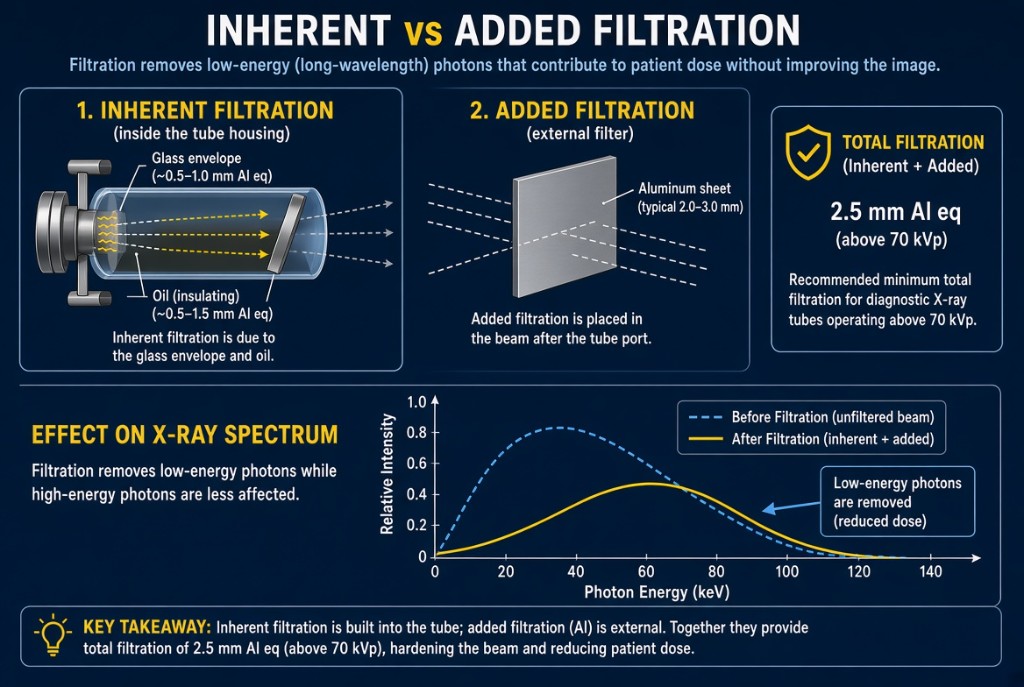
Total filtration = inherent + added. Above 70 kVp it must be at least 2.5 mm aluminum equivalent.
The rule
Total filtration is the sum of inherent filtration and added filtration. Inherent filtration is built into the x-ray tube itself. Added filtration is everything placed in the beam after the tube window. Filtration is expressed in millimeters of aluminum equivalent, meaning the thickness of aluminum that would attenuate the beam the same amount.
Inherent and Added Filtration
Two kinds
Inherent filtration comes from the glass or metal tube envelope, the insulating oil around it, and the tube window. It is typically about 0.5 to 1 mm aluminum equivalent. Added filtration includes thin aluminum sheets placed between the tube port and the collimator, plus the collimator itself. The collimator, mainly its mirror that reflects the light field, adds roughly 1 mm aluminum equivalent.
The numbers
The standard minimum is 2.5 mm aluminum equivalent total filtration for equipment operating above 70 kVp (NCRP); federal rules enforce it through minimum half-value layer requirements. Suppose inherent filtration is 0.5 mm, the collimator adds 1 mm, and a 1 mm aluminum sheet is installed at the tube port. The total is 0.5 + 1 + 1 = 2.5 mm, which meets the minimum. Remove the aluminum sheet and the total falls to 1.5 mm, which fails.
In practice
Inherent filtration increases as a tube ages, because vaporized tungsten coats the inside of the envelope and acts as an extra filter. The minimum filtration is built into the unit, not set by the radiographer for each exam, although some modern units also offer selectable copper filters. Physicists verify it by measuring the half-value layer. If the HVL is too low, the beam has too little filtration, and the patient's skin and superficial tissues absorb more low-energy photons that never reach the receptor.
Clinical Example
After a collimator replacement, the medical physicist measures the half-value layer at 80 kVp and finds it below the required value. The installer left out the added aluminum filter. The room stays out of service until the filter is installed and the HVL is rechecked.
Common Mistakes
- Calling the collimator mirror inherent filtration, although it sits outside the tube and counts as added filtration.
- Thinking the 2.5 mm must all be added filtration, when the requirement is for total filtration.
- Believing the radiographer sets the minimum filtration for each exam, when it is built into the unit and verified by the physicist.
- Forgetting that tube aging increases inherent filtration through tungsten deposits.
Why It Matters
Correct total filtration keeps useless low-energy photons out of the patient's skin. The registry asks you to name the sources of each type, add them up, and recall the 2.5 mm minimum.
Key Relationships
- Total filtration = inherent + added
- Inherent = envelope + oil + window
- Added = aluminum sheets + collimator, including the mirror
- Above 70 kVp → at least 2.5 mm Al equivalent total
- Low HVL → too little filtration