
Safety · Radiobiology2 min read5-question check
Acute Radiation Syndromes
A high whole-body dose in a short time: marrow fails first, then the gut, then the central nervous system.
The rule
Acute radiation syndrome, also called radiation sickness, follows a large whole-body dose delivered in a short time, minutes to hours. It is a deterministic response with a threshold. It has followed nuclear accidents and bombings, never diagnostic radiography. It runs through four stages: the prodromal stage of nausea, vomiting, and diarrhea within hours; a latent period when the person feels well; manifest illness; and finally recovery or death.
Acute radiation syndromes
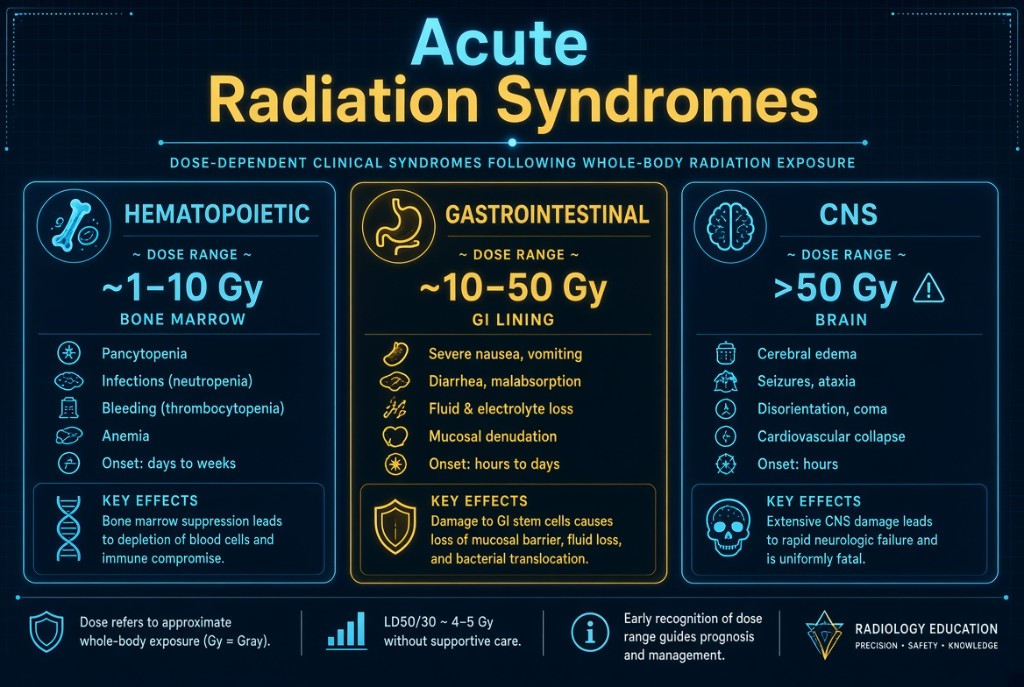
Three syndromes
Which syndrome appears depends on dose and on which cell population fails first. Exact ranges differ between textbooks, so learn the order and approximate doses. The hematopoietic syndrome, beginning at roughly 1 to 2 Gy, destroys stem cells in the bone marrow. Lymphocytes fall first, followed by other white cells, platelets, and red cells, leading to infection, bleeding, and anemia. With medical support, many patients at the lower end of this range survive. The gastrointestinal syndrome, at higher doses starting somewhere around 6 to 10 Gy, kills the cells lining the intestine, causing severe fluid loss, electrolyte imbalance, and infection, and is usually fatal. The central nervous system syndrome, above about 50 Gy, causes confusion, seizures, and loss of consciousness, with death within hours to a few days.
The numbers
The LD 50/30 is the whole-body dose expected to kill half of an exposed population within 30 days without treatment. For humans it is about 3 to 4 Gy. Worked example: a PA chest gives an entrance skin dose of roughly 0.1 mGy. Since 1 Gy equals 1,000 mGy, 3 Gy is 3,000 mGy, about 30,000 times that chest dose, and the chest dose is not even delivered to the whole body.
Clinical Example
A worker at an industrial irradiation facility is accidentally exposed and vomits within an hour, then feels fine for about two weeks before developing fever and bleeding gums. The vomiting was the prodromal stage, the quiet period was the latent stage, and the infection and bleeding show the hematopoietic syndrome as marrow output fails.
Common Mistakes
- Thinking the latent period means recovery, when damage is progressing while the person feels well.
- Mixing up the order: hematopoietic needs the lowest dose, CNS the highest.
- Linking acute radiation syndrome to diagnostic exams, which deliver thousands of times less dose.
- Forgetting that the syndrome requires a whole-body dose; a high dose to one hand does not cause it.
Why It Matters
Knowing these thresholds puts diagnostic doses in perspective when patients ask about risk. The registry tests the order of the syndromes, their approximate doses, the four stages, and the LD 50/30.
Key Relationships
- Hematopoietic: lowest dose, from roughly 1–2 Gy → marrow failure, infection, bleeding
- Gastrointestinal: higher dose, from roughly 6–10 Gy → intestinal lining destroyed
- CNS > 50 Gy → death within hours to days
- Prodromal → latent → manifest illness → recovery or death
- Human LD 50/30 ≈ 3–4 Gy without treatment